

A list of nine tasks can be modest on an empty Saturday and impossible on a Tuesday with five meetings. Counting the lines hides the difference between “order printer paper” and “rewrite the grant proposal,” then asks both days to meet the same standard.
Quick answer
There is no research-backed universal number of tasks to plan per day. Calculate true capacity instead: start with the time you can actually use, subtract fixed commitments, personal needs, transitions, and an uncertainty reserve, then admit tasks by estimated duration. Use past completion times when available. Three priorities can be a helpful display limit, but it is not a law. The method fails when estimates are missing or the day is unusually volatile.
At a glance
Best for: deciding how much movable work can fit around real commitments
Avoid when: emergency response, caregiving, illness, or shift work makes the day too unpredictable for task-level scheduling
Setup time: 10–15 minutes, faster after you build personal estimates
Daily effort: 3–5 minutes to check capacity and revise
Evidence level: planning bias, task-switching costs, and goal adjustment have research support; the calculator is a practical planning aid, not a validated scale
Task count is the wrong unit
A task count treats each checked box as equal. It is useful only when the tasks are roughly the same size.
A priority count limits how many items receive special attention. “Choose three priorities” may reduce visual competition, but it does not prove that three tasks fit.
True capacity is the amount of time and attention still available for movable work after the day pays its fixed costs.
The practical question is:
Which actions fit inside the capacity that remains, with enough room for ordinary variation?
That question may produce one task, three tasks, or twelve five-minute errands.
Why estimates become too optimistic
In the original planning-fallacy studies, participants' predictions for their own task completion were often too optimistic. Think-aloud data suggested they focused on future scenarios while discounting relevant past experience. In one study, explicitly connecting estimates to relevant past experiences removed the observed optimistic bias (Buehler, Griffin, & Ross, 1994).
Supported by research: people can underestimate completion time, and relevant past experience can improve forecasts under tested conditions.
Author recommendation: use the last three to five similar tasks as a starting estimate when you have them. Do not multiply every estimate by a fashionable universal factor.
Task transitions also have costs. Laboratory research finds slower and often more error-prone performance after switching between cognitive tasks, even when people have time to prepare (Monsell, 2003). That evidence does not establish a universal “23-minute rule” for real work. Your calendar should represent actual travel, setup, decompression, and context changes rather than a viral constant.
The true-capacity calculator
Use minutes so the arithmetic stays visible.
TRUE CAPACITY =
planning window
- fixed commitments
- personal operating needs
- known transitions
- uncertainty reserve
= movable task capacity
TRUE CAPACITY =
planning window
- fixed commitments
- personal operating needs
- known transitions
- uncertainty reserve
= movable task capacity
Then:
ADMITTED TASK LOAD =
sum of realistic task-duration ranges
ADMITTED TASK LOAD =
sum of realistic task-duration ranges
The plan is credible when the upper end of the admitted load fits inside true capacity, or when you have named which task will be dropped if estimates run long.
Line 1: define the planning window
Choose the period you are actually planning, not the full time between waking and sleeping.
Examples:
9:00 a.m.–5:30 p.m. workday: 510 minutes
6:00–9:30 p.m. personal evening: 210 minutes
10:00 a.m.–4:00 p.m. study window: 360 minutes
If you would not deliberately assign work to a minute, do not count it as capacity.
Line 2: subtract fixed commitments
Include:
meetings, classes, appointments, and shifts
commute or school pickup
required preparation and follow-up
fixed deadlines that consume time today
Do not count an all-day task as a fixed event merely because it has a due date. A deadline and a time reservation are different objects.
Line 3: subtract personal operating needs
Include lunch, medication routines, care responsibilities, and breaks that keep the day functional.
This line is not leftover time. It is part of the plan. Removing it from the spreadsheet does not remove it from the body.
Line 4: subtract known transitions
Name the transitions instead of adding an unexplained buffer:
20 minutes to travel from appointment to home
10 minutes to set up equipment
15 minutes to close one client context and open another
10 minutes after a meeting to capture decisions
Use your observed times. If a transition sometimes takes 5 minutes and sometimes 20, write the range.
The buffer-time guide explains how to place these gaps without turning the whole day into empty padding.
Line 5: reserve for uncertainty
An uncertainty reserve is capacity you deliberately leave unassigned because duration and interruptions are not fully knowable.
There is no universal correct percentage. Set it from the day:
use more when tasks are novel, collaborative, or interruption-prone
use less when work is familiar, bounded, and easy to stop
use a larger range when health, care, or service work makes availability unstable
After two weeks, compare planned and actual duration. Adjust the reserve from your own miss pattern rather than from someone else's productivity rule.
Line 6: estimate candidate tasks from the outside view
For each candidate, write:
minimum plausible duration
typical duration from similar work
plausible high duration
stopping point if time runs out
Example:
Task | Low | Typical | High | Stop rule |
|---|---|---|---|---|
Review contract changes | 30 | 45 | 70 | mark unresolved clauses |
Reply to support queue | 20 | 30 | 45 | stop after oldest 8 |
Draft launch outline | 45 | 60 | 90 | finish section headings |
If you have no base rate, treat the task as uncertain. Novel work deserves more room, not more confidence. The planning-fallacy guide gives a fuller method for using comparable past work instead of the best-case story.
The admission rule
Admit tasks in this order:
hard-consequence action that must move today
meaningful progress action
maintenance action
optional small work that fits only after the first three
Use the high estimate for novel or consequential work. Use the typical estimate for familiar, low-risk work when a clear stop rule exists.
If admitted load is greater than capacity, choose one action:
reduce scope
split the task at a meaningful stopping point
move it to a day with actual room
delegate it
delete or defer a lower-value commitment
Do not solve an overloaded plan by making every estimate smaller.
Copyable daily capacity sheet
PLANNING WINDOW:                 _____ min

FIXED COMMITMENTS
______________________________  _____
______________________________  _____

PERSONAL OPERATING NEEDS
______________________________  _____

TRANSITIONS
______________________________  _____

UNCERTAINTY RESERVE:             _____

TRUE CAPACITY:                   _____ min

CANDIDATE TASKS                  LOW / TYPICAL / HIGH
______________________________  ____ / _______ / ____
______________________________  ____ / _______ / ____
______________________________  ____ / _______ / ____

ADMITTED LOAD:                   _____ min
DROP FIRST IF NEEDED:            __________________
PLANNING WINDOW:                 _____ min

FIXED COMMITMENTS
______________________________  _____
______________________________  _____

PERSONAL OPERATING NEEDS
______________________________  _____

TRANSITIONS
______________________________  _____

UNCERTAINTY RESERVE:             _____

TRUE CAPACITY:                   _____ min

CANDIDATE TASKS                  LOW / TYPICAL / HIGH
______________________________  ____ / _______ / ____
______________________________  ____ / _______ / ____
______________________________  ____ / _______ / ____

ADMITTED LOAD:                   _____ min
DROP FIRST IF NEEDED:            __________________
Worked example: Tuesday with five meetings
Rina's work window is 8:30 a.m.–5:00 p.m., or 510 minutes.
Capacity line | Minutes |
|---|---|
Five meetings | 235 |
Lunch and short breaks | 55 |
Meeting notes and context transitions | 55 |
Uncertainty reserve | 45 |
True movable capacity | 120 |
Rina's candidate list has nine lines, but the high estimates total 305 minutes.
She admits:
confirm payroll exception: 20–30 minutes
revise the key chart for tomorrow: 55–75 minutes
send venue approval: 10 minutes
High estimate: 115 minutes. “Clean up the whole deck” moves to Wednesday because it has no credible stopping point inside today's remaining capacity.
Rina still sees nine tasks in the backlog. Only three have been promised today.
Worked example: an open Saturday
Dev has a six-hour window, or 360 minutes. The day has no meetings, but it is not empty.
Capacity line | Minutes |
|---|---|
Lunch and errands already promised | 75 |
Travel and setup | 30 |
Rest | 45 |
Uncertainty reserve for home repair | 60 |
True movable capacity | 150 |
The candidate tasks are mostly short:
order filters: 5 minutes
return two packages: 25 minutes
patch wall: 35–60 minutes
wash bedding: 10 active minutes
call parents: 30 minutes
organize entire garage: 3–5 hours
Dev admits five tasks totaling 130 minutes at their high estimates and leaves the garage project out. The plan contains more tasks than Rina's Tuesday because the tasks are smaller and the window is different.
Flexibility is part of capacity planning
A plan is not more serious because every goal survives unchanged. A 2025 meta-analytic review of 235 studies mapped how people disengage, reengage, or flexibly modify goals when circumstances change. The authors judged the accumulated evidence low to moderate overall because much of it was cross-sectional and heterogeneous, but the review supports treating goal adjustment as a legitimate self-regulation process rather than automatic failure (Riddell et al., 2025/2026).
An earlier meta-analysis found small associations between goal disengagement or reengagement capacities and quality of life, with important moderators and no basis for a simple causal claim (Barlow, Wrosch, & McGrath, 2020).
Research finding: flexible goal adjustment is associated with meaningful outcomes, but the evidence does not tell you exactly which Tuesday task to drop.
Ellie workflow recommendation: name the drop decision before the day starts. “If the vendor call runs past 2:00, move venue research” is more credible than assuming the rest of the plan will compress.
Use the calculator in Ellie
Open the calendar or Timebox first so fixed events are visible. Estimate the movable tasks, then drag only the admitted load into the day. Keep non-admitted work in Brain Dump or a list instead of hiding it below today's fold.
Ellie lets tasks remain separate from external calendar events, so a working block can be moved without changing the task's meaning (Ellie Timebox guide).
If the candidate list is still a mix of ideas, projects, and actions, use the brain-dump-to-plan worksheet before calculating capacity.
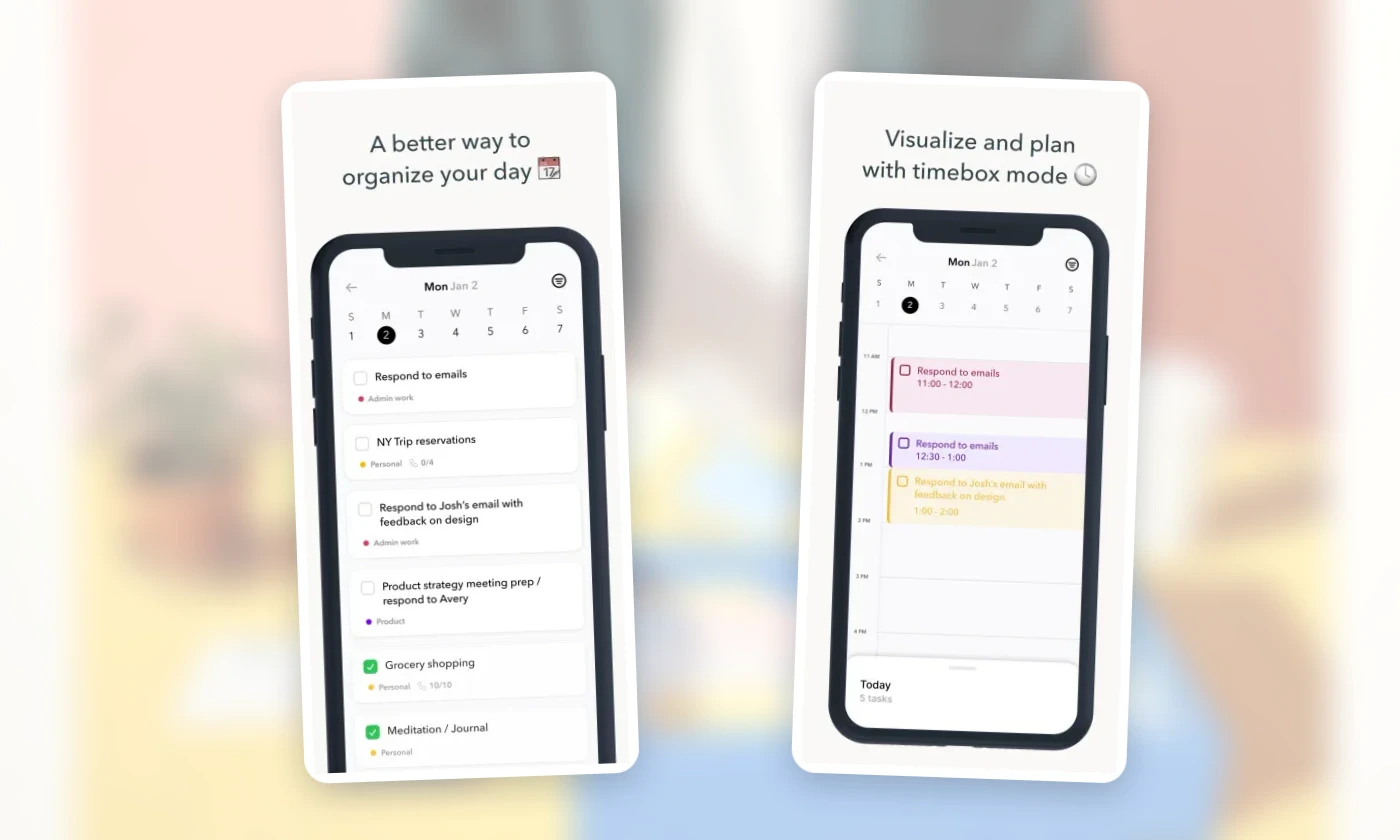
Official Ellie App Store screenshots, captured July 30, 2026. Interfaces and availability can change.
Without Ellie, use a paper calendar and index card. Write the capacity arithmetic at the top of the card, list admitted tasks below it, and keep the full backlog on another page. Apple Calendar plus Reminders also works if fixed events and scheduled tasks remain visually distinguishable.
The number on the card is not a target. It is permission to stop admitting work once the day is full.
A list of nine tasks can be modest on an empty Saturday and impossible on a Tuesday with five meetings. Counting the lines hides the difference between “order printer paper” and “rewrite the grant proposal,” then asks both days to meet the same standard.
Quick answer
There is no research-backed universal number of tasks to plan per day. Calculate true capacity instead: start with the time you can actually use, subtract fixed commitments, personal needs, transitions, and an uncertainty reserve, then admit tasks by estimated duration. Use past completion times when available. Three priorities can be a helpful display limit, but it is not a law. The method fails when estimates are missing or the day is unusually volatile.
At a glance
Best for: deciding how much movable work can fit around real commitments
Avoid when: emergency response, caregiving, illness, or shift work makes the day too unpredictable for task-level scheduling
Setup time: 10–15 minutes, faster after you build personal estimates
Daily effort: 3–5 minutes to check capacity and revise
Evidence level: planning bias, task-switching costs, and goal adjustment have research support; the calculator is a practical planning aid, not a validated scale
Task count is the wrong unit
A task count treats each checked box as equal. It is useful only when the tasks are roughly the same size.
A priority count limits how many items receive special attention. “Choose three priorities” may reduce visual competition, but it does not prove that three tasks fit.
True capacity is the amount of time and attention still available for movable work after the day pays its fixed costs.
The practical question is:
Which actions fit inside the capacity that remains, with enough room for ordinary variation?
That question may produce one task, three tasks, or twelve five-minute errands.
Why estimates become too optimistic
In the original planning-fallacy studies, participants' predictions for their own task completion were often too optimistic. Think-aloud data suggested they focused on future scenarios while discounting relevant past experience. In one study, explicitly connecting estimates to relevant past experiences removed the observed optimistic bias (Buehler, Griffin, & Ross, 1994).
Supported by research: people can underestimate completion time, and relevant past experience can improve forecasts under tested conditions.
Author recommendation: use the last three to five similar tasks as a starting estimate when you have them. Do not multiply every estimate by a fashionable universal factor.
Task transitions also have costs. Laboratory research finds slower and often more error-prone performance after switching between cognitive tasks, even when people have time to prepare (Monsell, 2003). That evidence does not establish a universal “23-minute rule” for real work. Your calendar should represent actual travel, setup, decompression, and context changes rather than a viral constant.
The true-capacity calculator
Use minutes so the arithmetic stays visible.
TRUE CAPACITY =
planning window
- fixed commitments
- personal operating needs
- known transitions
- uncertainty reserve
= movable task capacity
Then:
ADMITTED TASK LOAD =
sum of realistic task-duration ranges
The plan is credible when the upper end of the admitted load fits inside true capacity, or when you have named which task will be dropped if estimates run long.
Line 1: define the planning window
Choose the period you are actually planning, not the full time between waking and sleeping.
Examples:
9:00 a.m.–5:30 p.m. workday: 510 minutes
6:00–9:30 p.m. personal evening: 210 minutes
10:00 a.m.–4:00 p.m. study window: 360 minutes
If you would not deliberately assign work to a minute, do not count it as capacity.
Line 2: subtract fixed commitments
Include:
meetings, classes, appointments, and shifts
commute or school pickup
required preparation and follow-up
fixed deadlines that consume time today
Do not count an all-day task as a fixed event merely because it has a due date. A deadline and a time reservation are different objects.
Line 3: subtract personal operating needs
Include lunch, medication routines, care responsibilities, and breaks that keep the day functional.
This line is not leftover time. It is part of the plan. Removing it from the spreadsheet does not remove it from the body.
Line 4: subtract known transitions
Name the transitions instead of adding an unexplained buffer:
20 minutes to travel from appointment to home
10 minutes to set up equipment
15 minutes to close one client context and open another
10 minutes after a meeting to capture decisions
Use your observed times. If a transition sometimes takes 5 minutes and sometimes 20, write the range.
The buffer-time guide explains how to place these gaps without turning the whole day into empty padding.
Line 5: reserve for uncertainty
An uncertainty reserve is capacity you deliberately leave unassigned because duration and interruptions are not fully knowable.
There is no universal correct percentage. Set it from the day:
use more when tasks are novel, collaborative, or interruption-prone
use less when work is familiar, bounded, and easy to stop
use a larger range when health, care, or service work makes availability unstable
After two weeks, compare planned and actual duration. Adjust the reserve from your own miss pattern rather than from someone else's productivity rule.
Line 6: estimate candidate tasks from the outside view
For each candidate, write:
minimum plausible duration
typical duration from similar work
plausible high duration
stopping point if time runs out
Example:
Task | Low | Typical | High | Stop rule |
|---|---|---|---|---|
Review contract changes | 30 | 45 | 70 | mark unresolved clauses |
Reply to support queue | 20 | 30 | 45 | stop after oldest 8 |
Draft launch outline | 45 | 60 | 90 | finish section headings |
If you have no base rate, treat the task as uncertain. Novel work deserves more room, not more confidence. The planning-fallacy guide gives a fuller method for using comparable past work instead of the best-case story.
The admission rule
Admit tasks in this order:
hard-consequence action that must move today
meaningful progress action
maintenance action
optional small work that fits only after the first three
Use the high estimate for novel or consequential work. Use the typical estimate for familiar, low-risk work when a clear stop rule exists.
If admitted load is greater than capacity, choose one action:
reduce scope
split the task at a meaningful stopping point
move it to a day with actual room
delegate it
delete or defer a lower-value commitment
Do not solve an overloaded plan by making every estimate smaller.
Copyable daily capacity sheet
PLANNING WINDOW:                 _____ min

FIXED COMMITMENTS
______________________________  _____
______________________________  _____

PERSONAL OPERATING NEEDS
______________________________  _____

TRANSITIONS
______________________________  _____

UNCERTAINTY RESERVE:             _____

TRUE CAPACITY:                   _____ min

CANDIDATE TASKS                  LOW / TYPICAL / HIGH
______________________________  ____ / _______ / ____
______________________________  ____ / _______ / ____
______________________________  ____ / _______ / ____

ADMITTED LOAD:                   _____ min
DROP FIRST IF NEEDED:            __________________
Worked example: Tuesday with five meetings
Rina's work window is 8:30 a.m.–5:00 p.m., or 510 minutes.
Capacity line | Minutes |
|---|---|
Five meetings | 235 |
Lunch and short breaks | 55 |
Meeting notes and context transitions | 55 |
Uncertainty reserve | 45 |
True movable capacity | 120 |
Rina's candidate list has nine lines, but the high estimates total 305 minutes.
She admits:
confirm payroll exception: 20–30 minutes
revise the key chart for tomorrow: 55–75 minutes
send venue approval: 10 minutes
High estimate: 115 minutes. “Clean up the whole deck” moves to Wednesday because it has no credible stopping point inside today's remaining capacity.
Rina still sees nine tasks in the backlog. Only three have been promised today.
Worked example: an open Saturday
Dev has a six-hour window, or 360 minutes. The day has no meetings, but it is not empty.
Capacity line | Minutes |
|---|---|
Lunch and errands already promised | 75 |
Travel and setup | 30 |
Rest | 45 |
Uncertainty reserve for home repair | 60 |
True movable capacity | 150 |
The candidate tasks are mostly short:
order filters: 5 minutes
return two packages: 25 minutes
patch wall: 35–60 minutes
wash bedding: 10 active minutes
call parents: 30 minutes
organize entire garage: 3–5 hours
Dev admits five tasks totaling 130 minutes at their high estimates and leaves the garage project out. The plan contains more tasks than Rina's Tuesday because the tasks are smaller and the window is different.
Flexibility is part of capacity planning
A plan is not more serious because every goal survives unchanged. A 2025 meta-analytic review of 235 studies mapped how people disengage, reengage, or flexibly modify goals when circumstances change. The authors judged the accumulated evidence low to moderate overall because much of it was cross-sectional and heterogeneous, but the review supports treating goal adjustment as a legitimate self-regulation process rather than automatic failure (Riddell et al., 2025/2026).
An earlier meta-analysis found small associations between goal disengagement or reengagement capacities and quality of life, with important moderators and no basis for a simple causal claim (Barlow, Wrosch, & McGrath, 2020).
Research finding: flexible goal adjustment is associated with meaningful outcomes, but the evidence does not tell you exactly which Tuesday task to drop.
Ellie workflow recommendation: name the drop decision before the day starts. “If the vendor call runs past 2:00, move venue research” is more credible than assuming the rest of the plan will compress.
Use the calculator in Ellie
Open the calendar or Timebox first so fixed events are visible. Estimate the movable tasks, then drag only the admitted load into the day. Keep non-admitted work in Brain Dump or a list instead of hiding it below today's fold.
Ellie lets tasks remain separate from external calendar events, so a working block can be moved without changing the task's meaning (Ellie Timebox guide).
If the candidate list is still a mix of ideas, projects, and actions, use the brain-dump-to-plan worksheet before calculating capacity.
Official Ellie App Store screenshots, captured July 30, 2026. Interfaces and availability can change.
Without Ellie, use a paper calendar and index card. Write the capacity arithmetic at the top of the card, list admitted tasks below it, and keep the full backlog on another page. Apple Calendar plus Reminders also works if fixed events and scheduled tasks remain visually distinguishable.
The number on the card is not a target. It is permission to stop admitting work once the day is full.
Plan a day that can breathe
Ellie keeps tasks beside your calendar, so you can see your real capacity before the day fills up.
