

Buffer time is unassigned calendar space that pays for closing one activity, moving your body or location, recovering attention, and absorbing normal delay. Choose it by transition cost, not by adding the same percentage to every task. Five minutes may be enough between similar desk tasks; travel, emotional work, and high-stakes meetings may need far more.
Buffer is part of the task system
A calendar often models only the central events:
meeting ends at 10:00
writing begins at 10:00
appointment ends at 2:00
school pickup begins at 2:00
The missing work still happens:
capture decisions
use the bathroom
find the next file
travel and park
regulate after a difficult conversation
switch tools and environments
recover enough attention to begin
When those actions are omitted, the plan labels ordinary life as lateness.
Use the transition-cost test
Score the change on four dimensions.
Mode
Are you continuing the same kind of attention?
spreadsheet to spreadsheet: low
meeting to writing: medium
conflict to analysis: high
Place
Are you staying physically put?
same desk: low
different room or building: medium
travel, parking, security, or setup: high
Stakes
Does the next task punish a rushed start?
routine admin: low
client call: medium
interview, exam, medical appointment, or performance: high
Closure
How much does the current task need to be safely put down?
finished and documented: low
active but easy to resume: medium
unresolved with many details in mind: high
The higher the combined cost, the larger and more protected the buffer should be.
Starting ranges
These ranges are planning heuristics, not clinical or scientific standards.
Similar desk tasks: Start with 2–5 minutes.
Desk task to video meeting: Start with 5–10 minutes.
Meeting to focused work: Start with 10–20 minutes.
Back-to-back demanding meetings: Start with 15–30 minutes.
Local errand or appointment: Add travel time plus 10–20 minutes.
Emotional or high-stakes event: Protect 20–45 minutes when possible.
Use the smallest buffer that repeatedly works. If the same transition consumes more, update the model.
Why switching has a cost
Research on task switching shows measurable switch costs even in controlled tasks. In organizational research, Sophie Leroy described attention residue: when people move from one task to another while the first remains unfinished, part of their attention can remain with the prior task and reduce performance on the next one.
Buffer time does not erase every residue. It creates room to close, capture, and reorient instead of demanding an instantaneous mental teleport.
When the previous task remains open, write a two-minute closure note with where you stopped, what is unresolved, and the next action.
A buffer has a job
Name the buffer by its purpose:
Close buffer: capture decisions and next action.
Move buffer: travel, park, find the room, set up.
Recover buffer: eat, breathe, walk, or sit quietly.
Prepare buffer: open materials and review the goal.
Risk buffer: absorb normal overrun before a fixed commitment.
“Blank” time is easy to steal. A named buffer is still unassigned work capacity, but its value is visible.
Example: a meeting-heavy morning
The original plan:
9:00–9:30 meeting
9:30–10:15 write proposal
10:15–11:00 meeting
11:00–11:45 write proposal
This creates two proposal starts and assumes zero transition.
A better plan:
9:00–9:30 meeting
9:30–9:40 close and reset
9:40–10:05 proposal checkpoint
10:05–10:15 prepare
10:15–11:00 meeting
11:00–11:20 close, walk, and recover
11:20–12:10 proposal focus
The total scheduled proposal time is similar, but the second version acknowledges which session can support deeper work.
Do not turn buffer into advance capacity
The most common mistake is planning:
I have 30 minutes of buffer, so I can fit one more 30-minute task.
Once assigned, it is not buffer.
You may use unused recovery space later in the day, but decide at the time. Before the day starts, its purpose is to protect the plan from uncertainty.
Protect the buffer before fixed events
Buffers matter most before commitments with expensive lateness:
flights and trains
school pickup
medical appointments
live presentations
interviews
customer calls
medication or care routines
Work backward:
arrival time
check-in or setup
normal travel
plausible travel variation
closing the previous activity
The calendar event should include more than the official start.
Buffer for home life is real work
Switching from paid work to parenting, cooking, care, or study is not “free time between tasks.” Add transition space when possible:
close the work loop
change location or clothing
prepare food or materials
reduce sensory load
decide the first home action
This makes the boundary more humane and the next role easier to enter.
Measure one recurring transition
For one week, track a transition that keeps failing:
meeting to focus
home to gym
class to study
work to dinner
appointment to next commitment
Record planned buffer, actual ready-to-start time, and what consumed the gap. Then adjust the specific transition. There is no need to add 20 minutes everywhere because one commute is unreliable.
In Ellie, keep the buffer visible beside tasks and calendar events so it does not disappear inside optimistic planning.
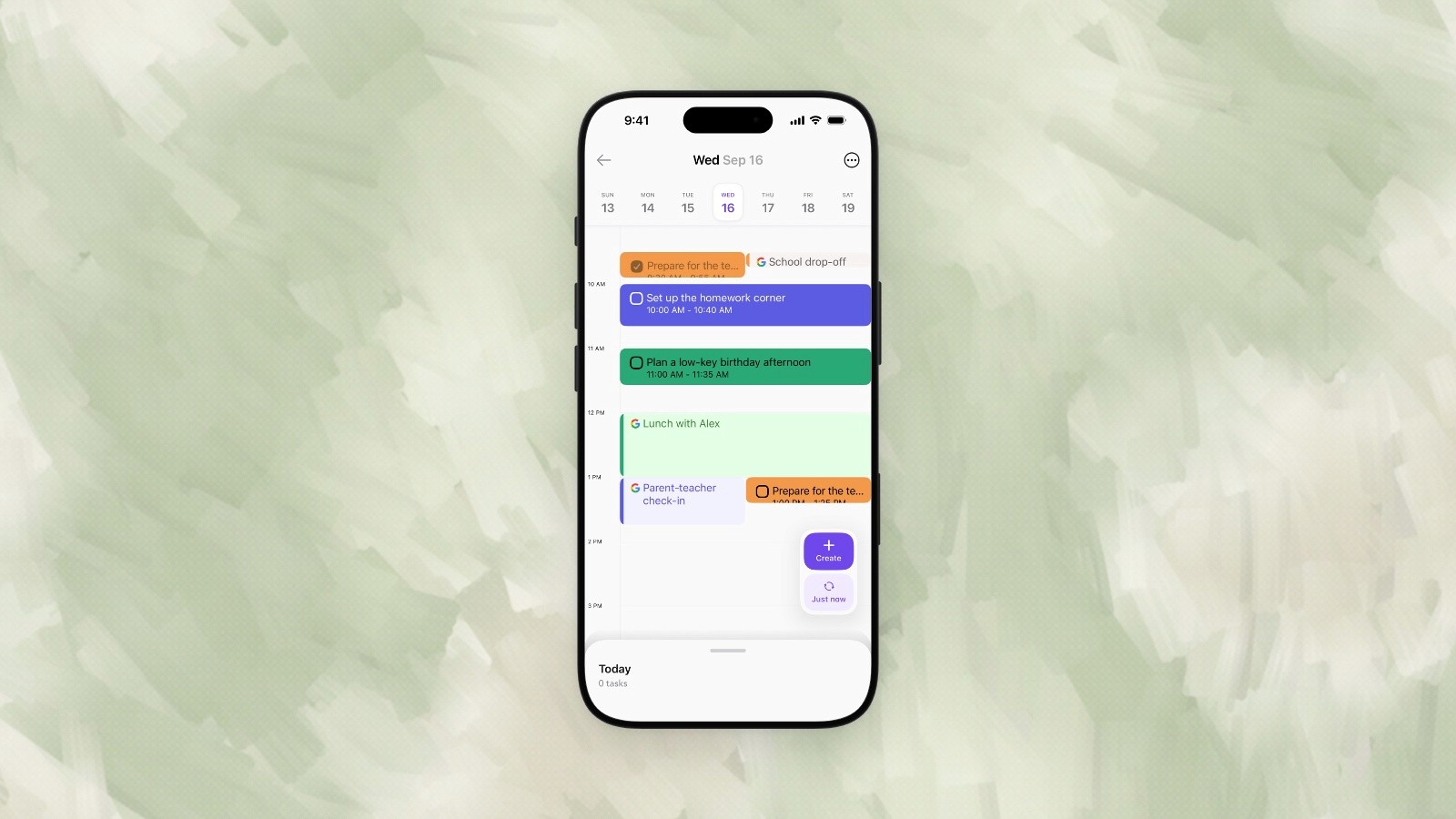
Timebox on iPhone shows tasks beside calendar events, with open space between commitments. Demo data.
Frequently asked questions
How much buffer time should I schedule each day?
There is no universal total. Begin with buffers around the highest-cost transitions and one larger recovery window. If your day is volatile, leave more open capacity rather than scattering tiny gaps everywhere.
Is buffer time wasted if nothing goes wrong?
No. It can become recovery, preparation, or a deliberate small task chosen in the moment. Its first value was protecting the commitments around it.
Should I put buffers on my calendar?
Put important buffers on the calendar, especially before fixed events and after demanding work. Tiny same-mode transitions may remain implicit once your schedule has enough open space.
What if meetings are always back-to-back?
Use a one- or two-minute closure note inside the meeting, schedule a longer recovery after the sequence, and avoid placing your hardest focus task immediately afterward when possible.
Sources
Leroy, “Why is it so hard to do my work? The challenge of attention residue when switching between work tasks”, Organizational Behavior and Human Decision Processes (2009).
Rubinstein, Meyer, and Evans, “Executive Control of Cognitive Processes in Task Switching”, Journal of Experimental Psychology: Human Perception and Performance (2001).
Plan a day that can breathe
Ellie keeps tasks beside your calendar, so you can see your real capacity before the day fills up.
