

The planning fallacy is the tendency to predict a task from its best-case story while underusing evidence from similar work. Correct it by starting with actual past durations, separating effort from elapsed time, naming uncertainty, and estimating the next checkpoint when the whole project is not yet knowable.
Why smart estimates still fail
When estimating, we imagine the future sequence:
Open the file, make the changes, check them, send.
That inside view feels detailed, but it quietly assumes:
the right file is available
the change is understood
no review uncovers a new issue
the tool works
no other commitment interrupts
“check” has a clear ending
In foundational experiments, Buehler, Griffin, and Ross showed that people often made optimistic predictions for their own future tasks even when they knew similar tasks had taken longer in the past. The important bias is not simple ignorance. People know delays happen; they treat this case as the exception.
Start with the outside view
The outside view asks:
What happened the last several times work like this was attempted?
Use the closest reference class available:
the last three newsletter drafts
the last two medical appointments, including travel and waiting
recent homework sets from the same course
similar bug fixes in the same codebase
previous grocery trips at the same time of day
The category should be similar enough to inform the estimate and broad enough to contain more than one lucky example.
Separate effort time from elapsed time
“This requires two hours of work” may still mean it cannot be completed today.
Track:
Effort time: minutes of active work.
Elapsed time: time from start to usable completion.
Dependency time: waiting for a person, file, approval, build, delivery, or event.
A design revision may need 90 minutes of effort across four days because feedback arrives asynchronously. Put effort on the calendar; put waiting in the project expectation.
Use a three-number estimate
For work you understand reasonably well, record:
Fast: conditions cooperate.
Likely: normal friction appears.
Slow: one plausible problem occurs.
Example:
Fast: 30 minutes
Likely: 50 minutes
Slow: 90 minutes
Schedule from the likely number. Use the slow number to decide whether a deadline or downstream commitment needs protection.
Do not average wildly different scenarios into a precise-looking 56 minutes. The range is information.
Add the invisible work
Many estimates include only the central action.
Use the COMPLETE check:
Collect materials and access
Open and orient
Make the core result
Proof or test
Link or package supporting material
Export, upload, or send
Transition and clean up
Explain or hand off
Not every task needs every step. The checklist exists to expose forgotten edges.
Estimate checkpoints when uncertainty is high
Do not guess the duration of work that has not been understood.
Estimate the next uncertainty-reducing checkpoint:
reproduce the bug
review the requirements
inspect the source data
draft the outline
identify the missing decision
test one technical approach
Then re-estimate with new information.
“Thirty minutes to determine whether this is a copy change or a component rebuild” is more honest and more useful than “two hours to finish.”
Use actual-to-estimated ratios
For repeated work, record planned and actual effort.
Suppose five recent tasks took:
30 minutes planned, 50 minutes actual.
60 minutes planned, 75 minutes actual.
45 minutes planned, 80 minutes actual.
30 minutes planned, 35 minutes actual.
90 minutes planned, 140 minutes actual.
Do not shame the difference. Ask what the tasks share. If your typical actual time is around 1.5 times the initial estimate, use that as a temporary correction for the same class of work.
The multiplier is not a permanent identity. It is a forecast based on current evidence.
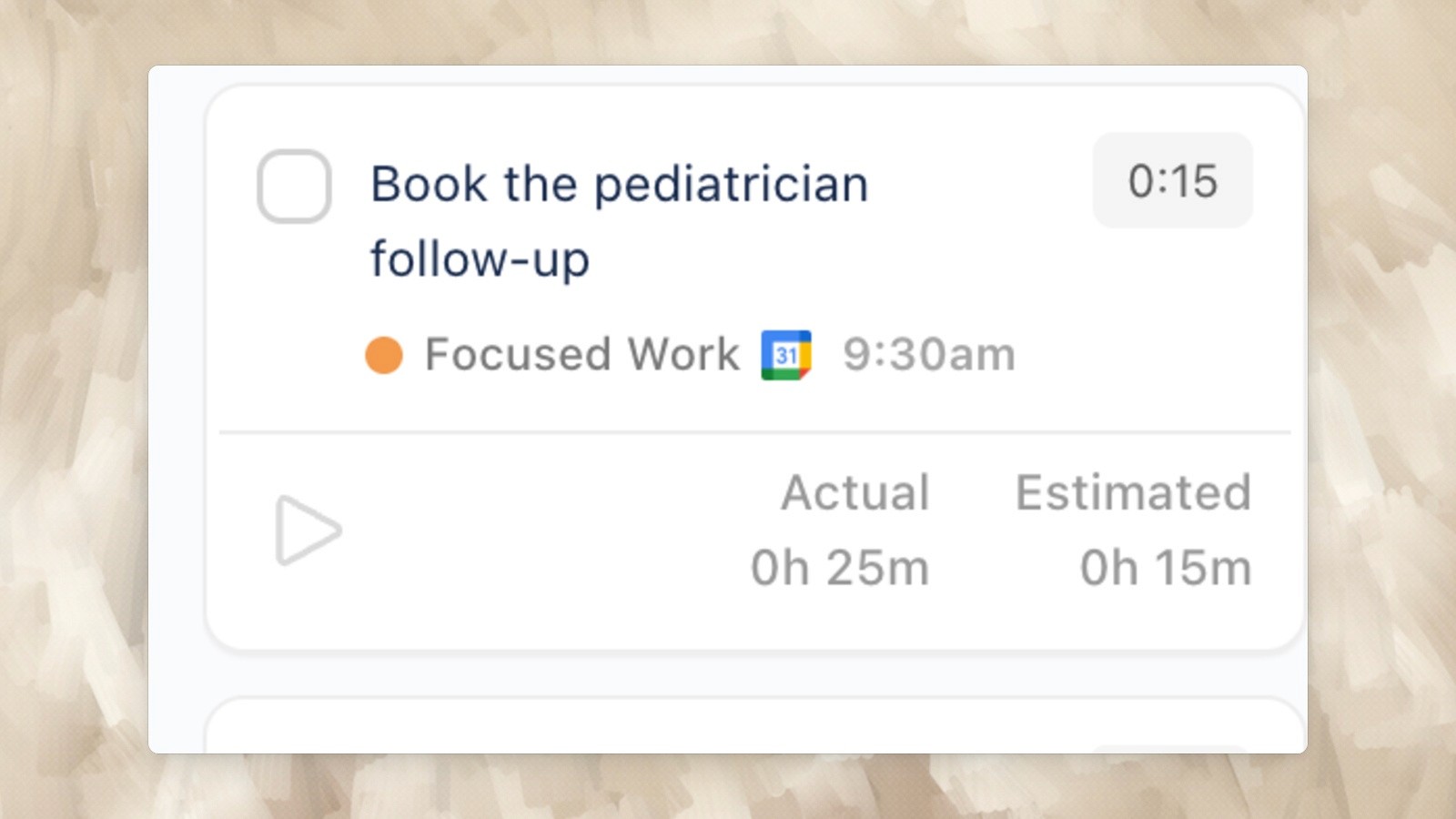
An Ellie demo task took 25 minutes against a 15-minute estimate. Compare the two before estimating similar work.
Example: estimating an article
Chris estimates “write article” at two hours.
The outside view shows:
research: 60–120 minutes
outline: 20–40 minutes
draft: 90–150 minutes
edit and source check: 45–90 minutes
CMS formatting and preview: 30–60 minutes
The project requires several sessions. Instead of putting “article, 2h” into tomorrow, Chris schedules:
60 minutes to establish the question and sources.
30 minutes to create an answer-first outline.
90 minutes for the first draft.
The remaining estimate becomes clearer after the draft exists.
Protect the day from estimates
Even good estimates should not fill every available minute.
Reserve unassigned time for transitions and normal delay. On a volatile day, use Flexible Time Blocking so an overrun changes one or two decisions rather than the entire schedule.
In Ellie, compare the task estimate with the open calendar window before committing it to today. A list can hold unlimited demand; a calendar cannot.
When adding a buffer is not enough
“Double every estimate” is a crude correction. It fails when:
the task is blocked, not merely slow
the scope is unclear
the risk is asymmetric
several people must coordinate
quality criteria have no boundary
the work is genuinely novel
In those cases, reduce uncertainty before predicting completion.
Frequently asked questions
What is a simple planning-fallacy correction?
Find the duration of the closest recent task and use it before imagining this one. If no reference exists, estimate a discovery checkpoint rather than the whole project.
Should I always double my estimate?
No. Use your own actual-to-estimated pattern for similar work. Some tasks need a modest correction; others need decomposition or dependency planning rather than more minutes.
Why do deadlines sometimes improve estimates?
They can force scope decisions and expose the stopping rule. They can also create unrealistic confidence. A deadline improves planning only when the deliverable and tradeoffs are explicit.
What if I never tracked actual time?
Start with three repeated task types this week. Approximate actual start and stop from calendars, file history, messages, or memory. Imperfect evidence is still a better beginning than a purely ideal story.
Sources
Buehler, Griffin, and Ross, “Exploring the ‘Planning Fallacy’”, Journal of Personality and Social Psychology (1994).
Kahneman and Lovallo, “Timid Choices and Bold Forecasts”, Management Science (1993), on the inside and outside views.
Plan a day that can breathe
Ellie keeps tasks beside your calendar, so you can see your real capacity before the day fills up.
