

A brain dump can feel relieving at 9:05 and accusatory by 9:10, when forty-seven lines have quietly become a new to-do list. “Book dentist” is beside “rethink onboarding,” a grocery item is beside a six-week project, and every line appears to be asking for today.
Quick answer
A brain dump becomes a realistic daily plan only after you clarify each item, constrain the day by available capacity, place a small number of actions, and park the rest somewhere trustworthy. Do not prioritize the whole dump or copy it into Today. First remove notes, wishes, duplicates, delegated work, and multi-step projects. Then choose actions that fit around fixed commitments. Capture creates visibility, not time, so the clarified list still has to fit the day you actually have.
At a glance
Best for: turning mental clutter into a short plan without losing useful ideas
Avoid when: the list contains urgent medical, legal, safety, or crisis needs that require professional action
Setup time: 15–30 minutes for a large dump
Daily effort: 5–10 minutes of clarification and placement
Evidence level: specific plan-making and progress monitoring have research support; the five-step worksheet is a practical Ellie workflow
A brain dump is not a to-do list
A brain dump is a capture surface. Its job is completeness without organization: tasks, concerns, ideas, reminders, names, and half-formed possibilities can all enter.
A to-do list contains actions you have decided to manage.
A daily plan contains the small subset you intend to attempt within one day's actual constraints.
Those are three different levels of commitment:
Capture says, “Do not lose this.”
A task says, “An action exists.”
A daily plan says, “This action has earned space today.”
One Ohio State-hosted student-services page suggests getting obligations out of your head before breaking projects into concrete actions and placing work around a calendar. It separates brain dumping, task decomposition, and time blocking rather than treating them as one step (Ohio State-hosted Time Management and Planning page).
That is unattributed university-hosted guidance, not proof that the phrase “brain dump” names one standardized psychological intervention. The page footer says its content is not reviewed or endorsed by Ohio State.
What research can and cannot tell us
In a series of experiments, Masicampo and Baumeister activated unfulfilled goals and found that unfinished goals could produce intrusive thoughts or interfere with unrelated tasks. Participants who formed specific plans no longer showed the same interference effects under the study conditions (Masicampo & Baumeister, 2011).
Supported by research: making a specific plan for unfinished goals can reduce cognitive interference in controlled tasks.
Not established by that study: writing every thought into an app will clear the mind, or that a five-step daily-planning worksheet improves job performance.
A separate meta-analysis of 138 randomized studies found that interventions designed to increase progress monitoring improved monitoring and, on average, promoted goal attainment. Effects were larger when progress was physically recorded or reported publicly (Harkin et al., 2016).
Supported by research: recording and checking progress can be useful for goal pursuit.
Ellie workflow recommendation: record only decisions you are willing to revisit. A forty-seven-item dump is useful input; it is a poor progress dashboard.
The Capture, Clarify, Constrain, Place, Park worksheet
Use one sheet of paper or one temporary document. Do not reorganize your permanent system while processing.
Step 1: Capture without assigning
Write each thought as it arrives. Do not add dates, labels, priority colors, or subprojects yet.
Set a boundary:
five minutes for a normal daily sweep
fifteen minutes after travel, illness, or a missed week
stop when the timer ends, even if your mind could produce more
The stop prevents capture from becoming an avoidance ritual.
Step 2: Clarify what each line is
Move down the dump once. Give every line one type:
Type | Test | Action |
|---|---|---|
Action | Can one visible behavior complete it? | rewrite with a verb |
Project | Does it require several actions? | name the outcome and first next action |
Event | Must it happen at a fixed time? | put the event on the calendar |
Reminder | Is remembering at a cue the main problem? | attach the cue |
Note | Is it information without a current action? | store as reference |
Waiting | Is someone else responsible for the next move? | record owner and follow-up date |
Delete | Would nothing meaningful happen if this vanished? | remove it |
“Website” is not a task. It might mean:
Project: publish the new pricing page
Next action: review the mobile pricing layout
Waiting: copy edits from Jo, follow up Thursday
Note: headline idea for later
If you cannot state the next visible action in a sentence, the item is not ready for today's plan.
The calendar versus to-do list guide helps when an item seems to belong everywhere.
Step 3: Constrain the day before choosing tasks
Write:
working window
fixed events
required personal commitments
transition and recovery space
remaining movable time
Do not count lunch, travel, or child pickup as available because no meeting covers them.
Then estimate candidate tasks using ranges when uncertainty is real:
review draft: 25–40 minutes
reply to five customer messages: 20–30 minutes
outline article: 45–75 minutes
The range is information. It is better than converting uncertainty into a precise but fictional number.
The true-capacity calculator shows how to decide how many of those tasks actually fit.
Step 4: Place a believable subset
Choose in this order:
Consequence task: one action whose delay creates a real cost today
Progress task: one action that advances a meaningful project
Maintenance task: one small action that keeps life or work running
Optional fillers: short tasks that fit only if time remains
This is not a universal “three-task rule.” A day may contain one complex task or eight tiny errands. The selection rule is capacity plus consequence, not a magic count.
Place the fixed events first. Add protected working blocks only where a task truly needs them. Leave some capacity visibly unclaimed.
Step 5: Park the rest with a reason
Every unchosen item gets one honest outcome:
a later date supported by available time
a project list
a waiting-for list with an owner
reference notes
someday/maybe
deleted
Avoid a generic “later” bucket that is simply another dump. If an item matters but cannot be scheduled yet, name the condition for reconsidering it: “Review after finance meeting” or “Revisit when fall travel dates are confirmed.”
A copyable worksheet
CAPTURE
[raw thoughts]

CLARIFY
Action:
Project + next action:
Event:
Reminder:
Note:
Waiting:
Delete:

CONSTRAIN
Working window:
Fixed commitments:
Personal/transition needs:
Movable time remaining:

PLACE
Consequence task:
Progress task:
Maintenance task:
Optional fillers:

PARK
Later date:
Project list:
Waiting for:
Reference:
Someday/maybe:
Delete:
CAPTURE
[raw thoughts]

CLARIFY
Action:
Project + next action:
Event:
Reminder:
Note:
Waiting:
Delete:

CONSTRAIN
Working window:
Fixed commitments:
Personal/transition needs:
Movable time remaining:

PLACE
Consequence task:
Progress task:
Maintenance task:
Optional fillers:

PARK
Later date:
Project list:
Waiting for:
Reference:
Someday/maybe:
Delete:
Worked example: forty-seven lines before a product launch
Cam's dump includes “launch,” “email Lena,” “fix screenshots,” “invoice,” “new onboarding maybe,” “dentist,” and forty-one other lines. The calendar has a noon review and school pickup at 3:15.
Clarification changes the list:
“launch” becomes the project outcome, not a task
“email Lena” becomes “Ask Lena to approve final copy by 11:00”
“fix screenshots” becomes “Replace three outdated App Store screenshots”
“invoice” becomes “Send June invoice to Orbit”
“new onboarding maybe” becomes a note for the next product cycle
“dentist” becomes “Call dentist for August cleaning,” a five-minute task
After fixed commitments and transitions, Cam has about three hours of movable time. The selected plan is:
45 minutes: send Lena the approval request and resolve comments
90 minutes: replace the three launch-blocking screenshots
15 minutes: send invoice
5 minutes: call dentist only if the launch review ends early
The other clarified actions move to the launch project or a later date. The dump still contains forty-seven captured thoughts; the day contains three commitments and one conditional errand.
Worked example: a student dump that mixes worry and work
Priya writes:
chemistry
email professor?
I am behind
groceries
quiz Friday
look up tutoring
chapter 6
should exercise
Not every line becomes a task.
“I am behind” is a concern. Priya uses it to inspect the syllabus, not as a task.
“chemistry” is a project area.
“quiz Friday” is a deadline.
“chapter 6” becomes “Answer the Chapter 6 practice questions without notes.”
“email professor?” becomes a decision: no email is needed after checking the course page.
“look up tutoring” becomes “Book a chemistry tutoring slot.”
groceries remain a short errand.
“should exercise” is parked rather than forced into an already full evening.
Priya has class until 4:00 and a shift at 7:00. The realistic plan is one 45-minute retrieval session, booking tutoring, and groceries on the route to work. A longer study block moves to tomorrow afternoon.
The constraint did not make Priya less ambitious. It prevented one overloaded evening from impersonating an academic recovery plan.
Use the worksheet in Ellie
Ellie's Brain Dump is designed as a capture space for tasks that arise before you decide where they belong. The official guide recommends reviewing it regularly rather than letting it grow without attention (Ellie Brain Dump guide).
Process it in place:
Delete notes and duplicates that should not be tasks.
Rewrite projects as next actions.
Move only the selected actions into Today or another believable day.
Drag protected work into the Timebox after checking fixed events.
Leave uncommitted actions in Brain Dump or a named list.
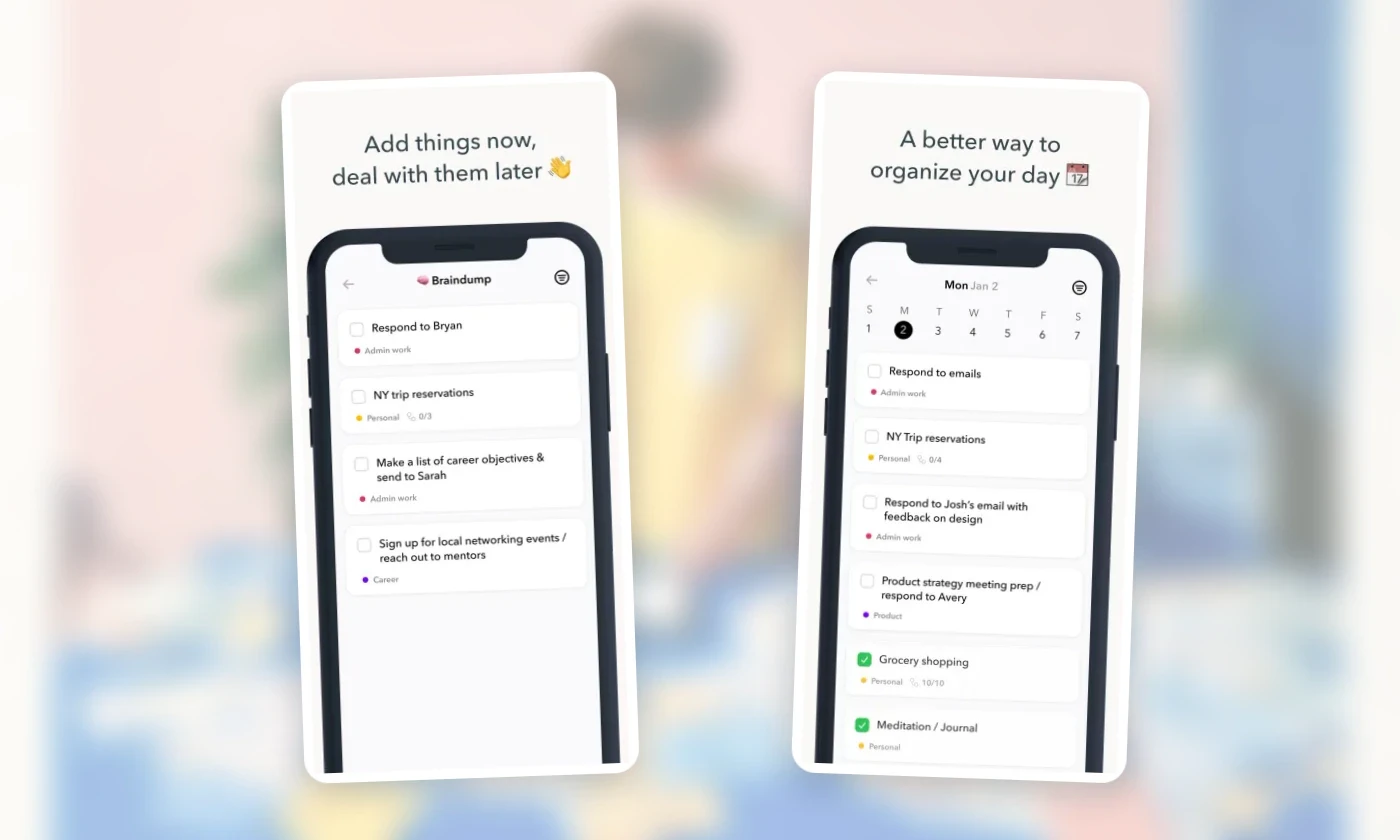
Official Ellie App Store screenshots, captured July 30, 2026. Interfaces and availability can change.
Ellie is not required. On paper, use one page for capture, circle true actions, put fixed events in a dated calendar, and transfer only today's chosen work to an index card. In Apple Reminders, keep an Inbox list and move selected actions into a Today smart list after checking Calendar.
When the clarified list is still too large, use the most-important-task method to protect one result without pretending the rest disappeared.
A brain dump can feel relieving at 9:05 and accusatory by 9:10, when forty-seven lines have quietly become a new to-do list. “Book dentist” is beside “rethink onboarding,” a grocery item is beside a six-week project, and every line appears to be asking for today.
Quick answer
A brain dump becomes a realistic daily plan only after you clarify each item, constrain the day by available capacity, place a small number of actions, and park the rest somewhere trustworthy. Do not prioritize the whole dump or copy it into Today. First remove notes, wishes, duplicates, delegated work, and multi-step projects. Then choose actions that fit around fixed commitments. Capture creates visibility, not time, so the clarified list still has to fit the day you actually have.
At a glance
Best for: turning mental clutter into a short plan without losing useful ideas
Avoid when: the list contains urgent medical, legal, safety, or crisis needs that require professional action
Setup time: 15–30 minutes for a large dump
Daily effort: 5–10 minutes of clarification and placement
Evidence level: specific plan-making and progress monitoring have research support; the five-step worksheet is a practical Ellie workflow
A brain dump is not a to-do list
A brain dump is a capture surface. Its job is completeness without organization: tasks, concerns, ideas, reminders, names, and half-formed possibilities can all enter.
A to-do list contains actions you have decided to manage.
A daily plan contains the small subset you intend to attempt within one day's actual constraints.
Those are three different levels of commitment:
Capture says, “Do not lose this.”
A task says, “An action exists.”
A daily plan says, “This action has earned space today.”
One Ohio State-hosted student-services page suggests getting obligations out of your head before breaking projects into concrete actions and placing work around a calendar. It separates brain dumping, task decomposition, and time blocking rather than treating them as one step (Ohio State-hosted Time Management and Planning page).
That is unattributed university-hosted guidance, not proof that the phrase “brain dump” names one standardized psychological intervention. The page footer says its content is not reviewed or endorsed by Ohio State.
What research can and cannot tell us
In a series of experiments, Masicampo and Baumeister activated unfulfilled goals and found that unfinished goals could produce intrusive thoughts or interfere with unrelated tasks. Participants who formed specific plans no longer showed the same interference effects under the study conditions (Masicampo & Baumeister, 2011).
Supported by research: making a specific plan for unfinished goals can reduce cognitive interference in controlled tasks.
Not established by that study: writing every thought into an app will clear the mind, or that a five-step daily-planning worksheet improves job performance.
A separate meta-analysis of 138 randomized studies found that interventions designed to increase progress monitoring improved monitoring and, on average, promoted goal attainment. Effects were larger when progress was physically recorded or reported publicly (Harkin et al., 2016).
Supported by research: recording and checking progress can be useful for goal pursuit.
Ellie workflow recommendation: record only decisions you are willing to revisit. A forty-seven-item dump is useful input; it is a poor progress dashboard.
The Capture, Clarify, Constrain, Place, Park worksheet
Use one sheet of paper or one temporary document. Do not reorganize your permanent system while processing.
Step 1: Capture without assigning
Write each thought as it arrives. Do not add dates, labels, priority colors, or subprojects yet.
Set a boundary:
five minutes for a normal daily sweep
fifteen minutes after travel, illness, or a missed week
stop when the timer ends, even if your mind could produce more
The stop prevents capture from becoming an avoidance ritual.
Step 2: Clarify what each line is
Move down the dump once. Give every line one type:
Type | Test | Action |
|---|---|---|
Action | Can one visible behavior complete it? | rewrite with a verb |
Project | Does it require several actions? | name the outcome and first next action |
Event | Must it happen at a fixed time? | put the event on the calendar |
Reminder | Is remembering at a cue the main problem? | attach the cue |
Note | Is it information without a current action? | store as reference |
Waiting | Is someone else responsible for the next move? | record owner and follow-up date |
Delete | Would nothing meaningful happen if this vanished? | remove it |
“Website” is not a task. It might mean:
Project: publish the new pricing page
Next action: review the mobile pricing layout
Waiting: copy edits from Jo, follow up Thursday
Note: headline idea for later
If you cannot state the next visible action in a sentence, the item is not ready for today's plan.
The calendar versus to-do list guide helps when an item seems to belong everywhere.
Step 3: Constrain the day before choosing tasks
Write:
working window
fixed events
required personal commitments
transition and recovery space
remaining movable time
Do not count lunch, travel, or child pickup as available because no meeting covers them.
Then estimate candidate tasks using ranges when uncertainty is real:
review draft: 25–40 minutes
reply to five customer messages: 20–30 minutes
outline article: 45–75 minutes
The range is information. It is better than converting uncertainty into a precise but fictional number.
The true-capacity calculator shows how to decide how many of those tasks actually fit.
Step 4: Place a believable subset
Choose in this order:
Consequence task: one action whose delay creates a real cost today
Progress task: one action that advances a meaningful project
Maintenance task: one small action that keeps life or work running
Optional fillers: short tasks that fit only if time remains
This is not a universal “three-task rule.” A day may contain one complex task or eight tiny errands. The selection rule is capacity plus consequence, not a magic count.
Place the fixed events first. Add protected working blocks only where a task truly needs them. Leave some capacity visibly unclaimed.
Step 5: Park the rest with a reason
Every unchosen item gets one honest outcome:
a later date supported by available time
a project list
a waiting-for list with an owner
reference notes
someday/maybe
deleted
Avoid a generic “later” bucket that is simply another dump. If an item matters but cannot be scheduled yet, name the condition for reconsidering it: “Review after finance meeting” or “Revisit when fall travel dates are confirmed.”
A copyable worksheet
CAPTURE
[raw thoughts]

CLARIFY
Action:
Project + next action:
Event:
Reminder:
Note:
Waiting:
Delete:

CONSTRAIN
Working window:
Fixed commitments:
Personal/transition needs:
Movable time remaining:

PLACE
Consequence task:
Progress task:
Maintenance task:
Optional fillers:

PARK
Later date:
Project list:
Waiting for:
Reference:
Someday/maybe:
Delete:
Worked example: forty-seven lines before a product launch
Cam's dump includes “launch,” “email Lena,” “fix screenshots,” “invoice,” “new onboarding maybe,” “dentist,” and forty-one other lines. The calendar has a noon review and school pickup at 3:15.
Clarification changes the list:
“launch” becomes the project outcome, not a task
“email Lena” becomes “Ask Lena to approve final copy by 11:00”
“fix screenshots” becomes “Replace three outdated App Store screenshots”
“invoice” becomes “Send June invoice to Orbit”
“new onboarding maybe” becomes a note for the next product cycle
“dentist” becomes “Call dentist for August cleaning,” a five-minute task
After fixed commitments and transitions, Cam has about three hours of movable time. The selected plan is:
45 minutes: send Lena the approval request and resolve comments
90 minutes: replace the three launch-blocking screenshots
15 minutes: send invoice
5 minutes: call dentist only if the launch review ends early
The other clarified actions move to the launch project or a later date. The dump still contains forty-seven captured thoughts; the day contains three commitments and one conditional errand.
Worked example: a student dump that mixes worry and work
Priya writes:
chemistry
email professor?
I am behind
groceries
quiz Friday
look up tutoring
chapter 6
should exercise
Not every line becomes a task.
“I am behind” is a concern. Priya uses it to inspect the syllabus, not as a task.
“chemistry” is a project area.
“quiz Friday” is a deadline.
“chapter 6” becomes “Answer the Chapter 6 practice questions without notes.”
“email professor?” becomes a decision: no email is needed after checking the course page.
“look up tutoring” becomes “Book a chemistry tutoring slot.”
groceries remain a short errand.
“should exercise” is parked rather than forced into an already full evening.
Priya has class until 4:00 and a shift at 7:00. The realistic plan is one 45-minute retrieval session, booking tutoring, and groceries on the route to work. A longer study block moves to tomorrow afternoon.
The constraint did not make Priya less ambitious. It prevented one overloaded evening from impersonating an academic recovery plan.
Use the worksheet in Ellie
Ellie's Brain Dump is designed as a capture space for tasks that arise before you decide where they belong. The official guide recommends reviewing it regularly rather than letting it grow without attention (Ellie Brain Dump guide).
Process it in place:
Delete notes and duplicates that should not be tasks.
Rewrite projects as next actions.
Move only the selected actions into Today or another believable day.
Drag protected work into the Timebox after checking fixed events.
Leave uncommitted actions in Brain Dump or a named list.
Official Ellie App Store screenshots, captured July 30, 2026. Interfaces and availability can change.
Ellie is not required. On paper, use one page for capture, circle true actions, put fixed events in a dated calendar, and transfer only today's chosen work to an index card. In Apple Reminders, keep an Inbox list and move selected actions into a Today smart list after checking Calendar.
When the clarified list is still too large, use the most-important-task method to protect one result without pretending the rest disappeared.
Plan a day that can breathe
Ellie keeps tasks beside your calendar, so you can see your real capacity before the day fills up.
