

Flexible time blocking protects a few non-negotiable anchors, assigns the rest of the work to movable windows, and reserves recovery space before the day begins. When an interruption happens, you move a category of work by rule instead of rebuilding every task appointment.
Why rigid time blocks collapse
A rigid plan assumes three things:
tasks take the expected amount of time
commitments begin and end on time
no meaningful new demand appears
Most consumer workdays include school pickup, appointments, family needs, messages, errands, unpredictable energy, or other people’s delays. When each task has one exact slot, a 20-minute interruption can invalidate the rest of the calendar.
Researchers studying interrupted work have found that people often compensate by working faster, while also reporting more stress, frustration, effort, and time pressure. The lesson is not that interruptions are always avoidable. It is that a plan should not require constant acceleration after one occurs.
Use three layers: anchors, flex windows, recovery
Anchors
Anchors are commitments that should not move casually:
appointments
classes
pickup and care responsibilities
a protected focus session
meals or medication timing
a true deadline handoff
Keep the anchor list short. If everything is an anchor, nothing can absorb change.
Flex windows
A flex window protects a work mode rather than one fragile task:
focused project work
calls and communication
errands outside the house
study and practice
household reset
low-energy admin
Place the highest-value eligible task into the window when it begins. If that task is blocked, another task with the same context can use the time.
Recovery space
Recovery space is deliberately unassigned capacity. It pays for:
overruns
transitions
urgent requests
an actual break
a task that took longer for a good reason
Start with 30 to 90 minutes across the day, depending on volatility. This is an Ellie heuristic, not a scientific optimum. Track whether you repeatedly consume all of it.
The anchor-flex-recovery template
Here is a day with five fixed commitments:
8:30–9:00: school drop-off
10:30–11:00: appointment
12:00–12:30: lunch
2:00–2:30: team call
4:30–5:00: pickup
Instead of squeezing ten tasks into the gaps, add:
9:00–10:15: focus window
11:15–12:00: communication window
12:30–1:30: movable project window
1:30–2:00: recovery
2:30–3:30: focus or errands, chosen at 2:25
3:30–4:15: recovery and close
The plan still makes commitments. It simply commits at the right resolution.
Give every window a fallback
Before the day starts, assign:
Primary task: the best use if conditions cooperate.
Fallback task: useful work with fewer dependencies.
Minimum version: the smallest result that still matters.
Example:
Primary: edit the full presentation.
Fallback: write speaker notes for slides 1–5.
Minimum: identify the three slides that require a decision.
An interruption then changes scope before it destroys the whole block.
Use a two-minute replan
When reality changes, do not drag every future task immediately.
Ask:
What is still fixed?
What consequence appears today if this work moves?
Can I shrink the outcome?
Which flex window can receive it?
What will I deliberately release?
Then update only the next two meaningful windows. The rest of the day remains provisional.
This is the near-horizon rule: after disruption, plan in detail only as far as current information is reliable.
Example: an appointment runs late
Sam planned a 60-minute project block at 12:30. The appointment ends 35 minutes late.
A rigid plan offers two bad choices: skip lunch or push every later block.
The flexible version:
keeps lunch
uses the remaining 25 minutes for the minimum project outcome
preserves the 2:00 call
moves the project’s primary task into the 2:30 flex window
drops a low-consequence errand
The day changes, but the decision system survives.
Build interruption rules before interruptions
Create rules for recurring disruptions:
If a call overruns by less than 15 minutes, use recovery space.
If it overruns by more than 15 minutes, shrink the next flex outcome.
If a family need appears, protect the next anchor and release the lowest-consequence block.
If a task is blocked, use the fallback task in the same mode.
If energy falls sharply, swap focus work with a low-energy window rather than deleting rest.
Rules reduce the number of decisions made while stressed.
Do not schedule from task count
Five tasks can require 40 minutes or six hours. Estimate enough to see whether the plan fits, but avoid false precision.
Use ranges:
quick: under 15 minutes
standard: 20–45 minutes
substantial: 60–120 minutes
project: requires several sessions
If two substantial tasks compete for one 75-minute window, the calendar has already answered: both cannot be today’s primary outcome.
Improve those estimates with evidence from similar past work rather than the best-case story for this task.
Keep the calendar readable
Avoid putting every two-minute action on the timeline. A useful calendar should show:
fixed commitments
protected work modes
meaningful transitions
recovery capacity
genuine deadlines
Keep the detailed action list in the task system. In Ellie, tasks can remain in a list until you choose which ones deserve a real window.
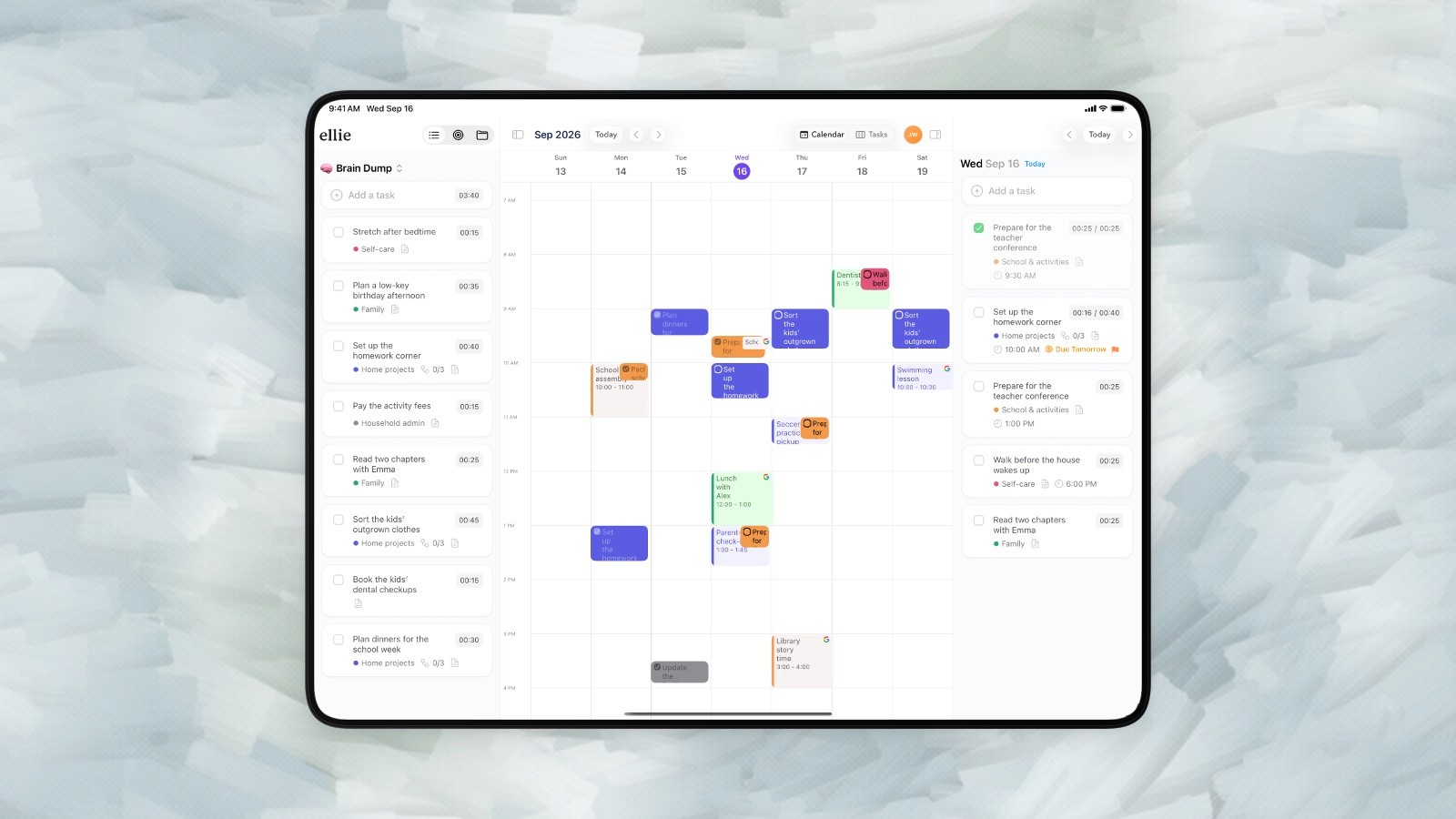
A weekly view in Ellie makes both scheduled blocks and open space visible. Demo data.
When flexible blocking becomes too loose
Flexibility is not “do whatever feels best.”
Watch for:
always choosing the easiest fallback
moving the same task without changing scope
treating recovery space as spare capacity before the day starts
leaving primary outcomes unnamed
allowing messages to enter every window
Keep one clear outcome per flex window and review repeated moves at the end of the week.
Frequently asked questions
How much of my day should I time block?
There is no universal percentage. Start by blocking fixed commitments and one or two high-value windows. Leave enough unassigned time to absorb your normal volatility, then adjust from actual days.
What if my job is interrupt-driven?
Use shorter flex windows, a visible triage rule, and a fallback list of work that can stop safely. Protect only the few tasks that truly require isolation.
Should I move missed blocks to tomorrow?
Only after deciding whether the work is still important, should be reduced, or belongs in a project rather than a daily plan. Automatic rollover hides chronic overcommitment.
Is flexible time blocking still time blocking?
Yes. You are still reserving time intentionally. The block is defined by purpose and constraints rather than a brittle promise that one task will behave exactly as predicted.
Related planning guides
First decide what belongs on your calendar versus your to-do list. Then compare timeboxing and time blocking if a task needs a firm stopping rule.
Sources
Mark, Gudith, and Klocke, “The Cost of Interrupted Work: More Speed and Stress”, CHI (2008).
Leroy, “Why is it so hard to do my work?”, research on attention residue after switching tasks (2009).
Ellie, Time Blocking 101.
Plan a day that can breathe
Ellie keeps tasks beside your calendar, so you can see your real capacity before the day fills up.
