

If time does not feel reliable, make it observable. Use visible clocks or timers, connect tasks to real calendar windows, plan only the next part of the day in detail, and create external transition cues before commitments. The goal is not to develop a perfect inner clock. It is to reduce how often the plan depends on one.
What “time blindness” means here
“Time blindness” is a common informal term for difficulty perceiving, estimating, or acting on time. It is not a standalone diagnosis. ADHD research includes many different timing tasks, and individual experiences vary.
A systematic review and meta-analysis reported time-perception differences associated with ADHD across the lifespan. Reviews of adult ADHD also show that findings differ by the kind of timing task and study design.
That supports taking time difficulties seriously. It does not mean every late arrival or poor estimate has one cause, or that the strategies below replace assessment and treatment.
Stop asking time to remain invisible
Many plans represent time as text:
finish report
shower
leave
appointment
The tasks have no visible size and the transitions have no existence.
Externalize four things:
Current time
Time remaining
Expected task size
The moment transition begins
A large analog clock, visual countdown, persistent menu-bar timer, or calendar timeline can help. Choose one display that stays available without requiring you to unlock a distracting device.
Use the now-next-later horizon
Planning an entire day in equal detail can create a beautiful model that is obsolete by noon.
Divide the day:
Now: one visible action.
Next: the next commitment and its transition.
Later: a short priority queue, not exact minute-by-minute promises.
After each anchor, update now and next. This keeps planning close to the information you actually have.
Put transitions on the clock
“Appointment at 3:00” is not the action cue.
Work backward:
3:00 appointment
2:50 arrive and check in
2:25 leave
2:15 find keys, water, documents
2:10 stop current task and save state
Set the cue at 2:10 or 2:15, not only at 3:00.
Use two signals when useful:
Prepare signal: begin closing and collecting.
Go signal: physically leave or change mode.
The first signal protects the second.
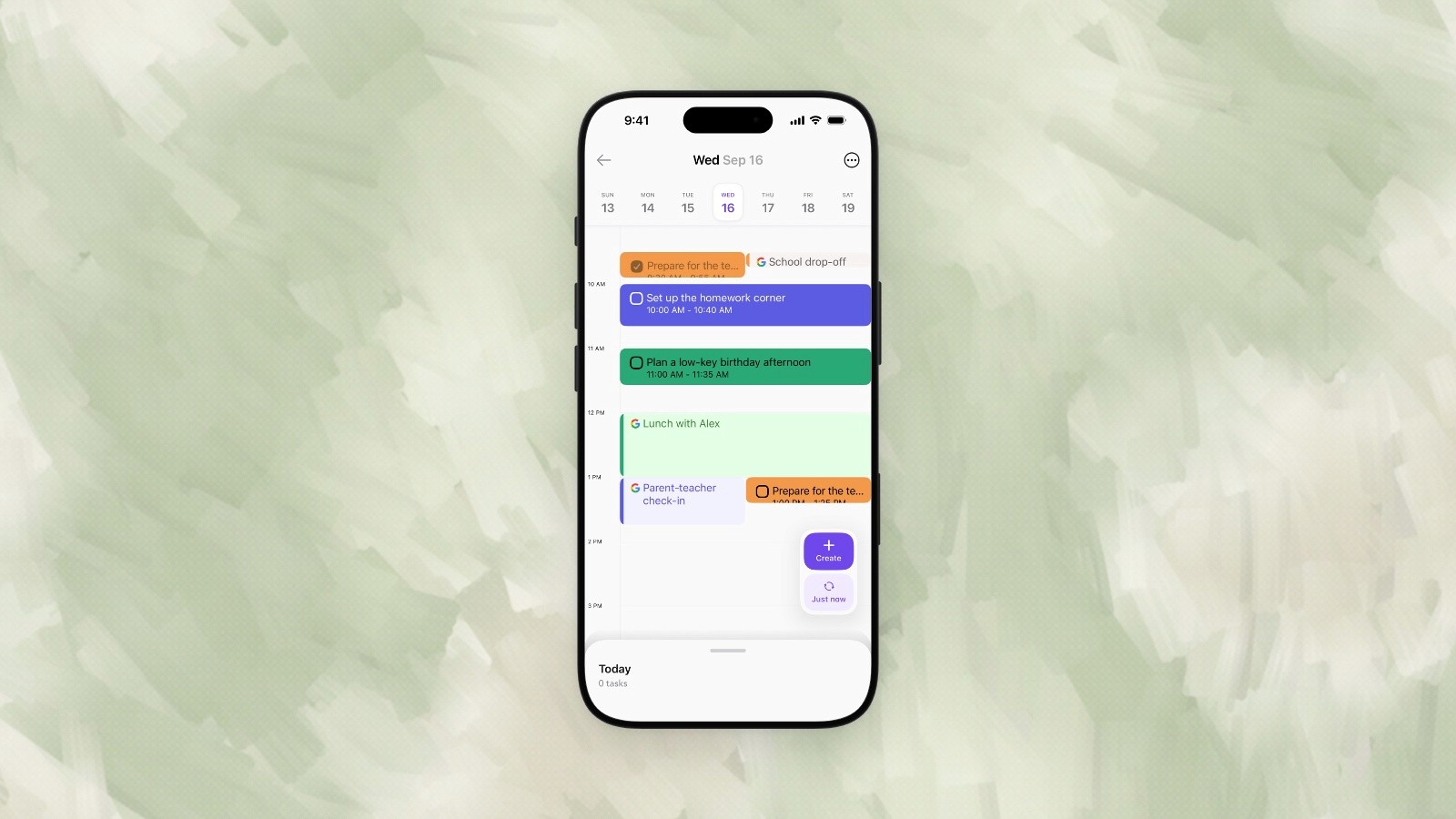
A visual day in Ellie turns planned work into blocks with visible start and end times. Demo data.
Turn estimates into visible containers
A task list can make 15 minutes and three hours look equal.
Use rough size labels:
pebble: under 10 minutes
block: 15–40 minutes
session: 45–90 minutes
project: several sessions
The names are intentionally simple. Place only work that fits the visible window. If a “session” has 25 minutes available, choose a checkpoint rather than pretending the whole task fits.
For better estimates, use the outside-view process in The Planning Fallacy.
Create a launch sequence
Transitions often fail because “start” still contains several actions.
For a study session:
Put phone in the charging spot.
Open the assignment.
Set a 15-minute launch timer.
Write the first answer or question.
For leaving home:
Shoes on.
Keys and required item in hand.
Check route.
Cross the doorway.
Use the same sequence until it becomes recognizable. A sequence is easier to cue than an abstract state like “be ready.”
Add a time anchor to recurring tasks
Attach a task to something that already happens:
after coffee, review today’s first calendar window
when class ends, open the next assignment before leaving
after lunch, check the next transition alarm
when the work shutdown begins, place tomorrow’s first materials
This is an implementation intention: a specific cue is linked to a specific response. Make both parts concrete enough that another person could recognize them.
Example: a morning that keeps running late
Taylor plans:
shower
breakfast
leave by 8:30
The list has no sizes. Taylor begins one more household task at 8:10 because 20 minutes still feels available.
The visible version:
7:35–7:55 shower and dress
7:55–8:10 breakfast
8:10 prepare-to-leave alarm
8:20 shoes, bag, keys
8:25 cross-doorway target
8:30 risk buffer
The critical change is not tighter discipline. The transition begins before the official departure and remains visible.
Use neutral review, not retrospective prosecution
At the end of a missed transition, record:
What time did I notice?
What was I doing?
Which cue was absent or ignored?
Was the estimate wrong, or did a new task enter?
What external change would help next time?
“I should care more” is not a system change.
Possible changes:
move the alarm farther from the event
use a different sound
add a physical object by the door
reduce the previous task’s scope
ask another person for a cue
leave a larger buffer
When a productivity technique is not enough
Time difficulties can interact with sleep, anxiety, depression, medication, chronic illness, pain, caregiving, and working conditions. Seek qualified support when lateness, missed care, driving risk, employment problems, or severe distress persist.
Tools should reduce danger and shame, not promise to treat a health condition.
Frequently asked questions
Is time blindness officially part of ADHD?
The informal term is widely used, while research more precisely studies time perception, estimation, reproduction, and prospective memory. ADHD is diagnosed through established clinical criteria, not one experience.
Are visual timers good for ADHD?
They can make remaining time externally visible and may be useful for some people. They are a support, not a diagnostic test or treatment. Stop using one if it increases distress.
Why do alarms stop working?
The cue may occur too late, become familiar, lack a specific action, or appear while another task still has a strong grip. Change the cue, timing, location, and required response rather than only increasing volume.
Should every task have a timer?
No. Use timers where time disappears, starting is difficult, or a transition matters. Too many cues can become background noise.
Sources
Zhang et al., “Time-Perception Deficits in Attention-Deficit/Hyperactivity Disorder: A Systematic Review and Meta-Analysis”, Developmental Neuropsychology (2023).
Marx et al., “Time Perception in Adult ADHD: Findings from a Decade—A Review”, International Journal of Environmental Research and Public Health (2023).
Gollwitzer and Sheeran, meta-analysis of implementation intentions, Advances in Experimental Social Psychology (2006).
Plan a day that can breathe
Ellie keeps tasks beside your calendar, so you can see your real capacity before the day fills up.
