5 TickTick Alternatives for Different Ways of Planning

Chris Raroque
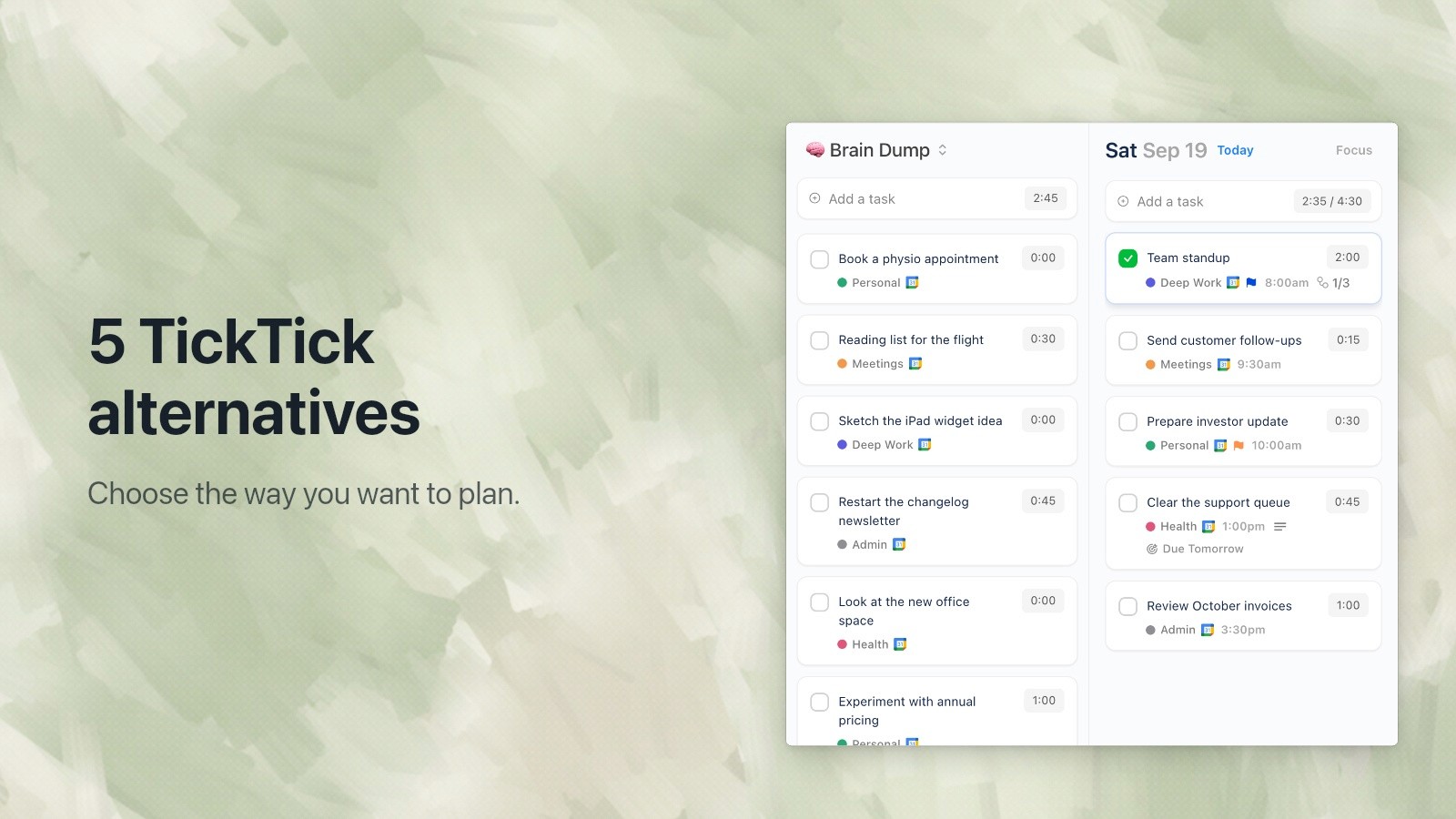
The best TickTick alternative depends on what you want to change. Todoist is a strong place to start for organizing tasks and projects. Ellie is worth trying for choosing a realistic day from a larger list. Structured emphasizes a visual timeline. Sunsama adds a guided planning routine. Microsoft To Do provides a free daily shortlist.
You may also be better off staying with TickTick. It already combines tasks, a focus timer, habits, and calendar features. Moving to another app only helps if it addresses the part of that setup that is not working for you.
Ellie is our product, so this is a comparison from a competing planner. We checked the linked product documentation and web prices on September 19, 2026. We are not claiming to have completed a hands-on benchmark of all five apps.
Start with the reason you want to leave
What you want | Try first | Main tradeoff |
|---|---|---|
A task system organized around projects and filters | Todoist | Calendar layout and task duration are paid features. |
A clear separation between everything to do and today’s plan | Ellie | Timeboxing is paid, and there is no native Android app. |
A visual timeline for the day | Structured | Feature availability varies across Apple, Android, and web. |
Help deciding what fits through a daily planning routine | Sunsama | Higher ongoing subscription cost. |
A simple free daily list | Microsoft To Do | A daily shortlist does not itself reserve time for the work. |
Before comparing prices, write one sentence: “I want to switch because ___.” Keep that sentence visible during your trial. Otherwise, you can spend a weekend reorganizing tasks without fixing the original problem.
1. Todoist: for projects, task organization, and a familiar list
Todoist is a sensible alternative if you want your task manager to remain the main place where work is organized. Its current Beginner plan includes five personal projects, list and board layouts, and task reminders. Pro expands the limits and includes a calendar layout and task duration. It is outdated to describe Todoist as having no calendar view. Todoist pricing and features.
Try it with one active project. Add a few tasks, give them meaningful dates, and see whether the way you organize work feels easier to maintain than your existing TickTick setup. If time blocking is central to your decision, evaluate the relevant paid features rather than comparing only the free task lists.
Cost: Free tier; Pro is $7/month or $60/year on the U.S. web pricing page. Current Todoist pricing.
Choose it when: Your difficulty is managing the work across several projects.
Keep looking when: Your projects are already organized, but you still struggle to decide how much work belongs in a single day.
2. Ellie: for turning a large list into today’s plan
Ellie separates collecting tasks from deciding when to do them. You can keep ideas in Brain Dump, choose what belongs on a day, and use Timebox to place work beside your calendar. That makes it a candidate when the list itself is fine but it keeps expanding beyond the time you have. Ellie.
Ellie also offers a task timer, including Pomodoro mode. You do not have to give up every focus feature when considering a different planning workflow. Availability and controls differ by platform, so check the task timer guide for the device you use.
Cost: Free for basic tasks and Brain Dump. Pro is $9.99/month or $99.99/year; Lifetime is $299.99. Timebox and calendar integrations are Pro features. Ellie supports Mac, Windows, web, iPhone, and iPad, with no native Android app currently. Ellie pricing.
Choose it when: You want to decide what today can hold and place the work yourself.
Keep looking when: A native Android app or a broad team project system is essential to your workflow.
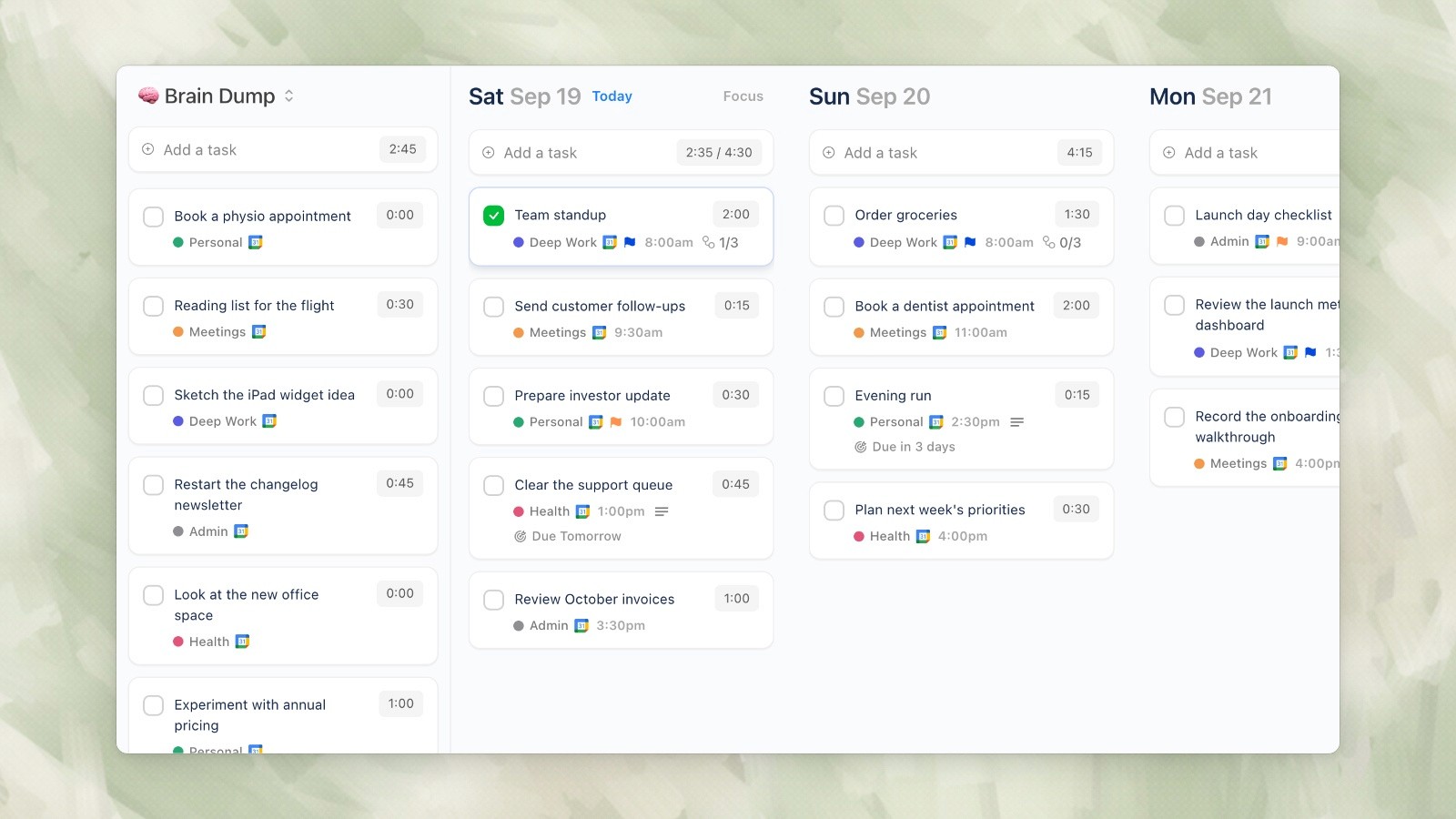
Ellie desktop demo data, captured September 19, 2026.
3. Structured: for seeing the day as a timeline
Structured is worth evaluating if a sequence of activities is easier for you to understand than several lists. The product is available across Apple devices, Android, and web, but the experience is not identical everywhere. Check the platform comparison before relying on a particular feature. Structured’s platforms, feature availability.
Try planning a morning with a meeting, one work block, lunch, and a personal errand. Then change the meeting time. The decision is whether this way of seeing and adjusting the day is useful enough to replace the task organization you already have.
Cost: Free access with paid Pro options. Check the current price shown in the app for your platform and region; Structured’s upgrade guidance explains where to find those offers. Structured Pro.
Choose it when: The timeline is the part you want to use most.
Keep looking when: A feature you need has not reached your device, or your main need is managing a large set of projects rather than following a day.
4. Sunsama: for a guided daily planning routine
Sunsama is a candidate when deciding what fits is the missing step between your task list and your calendar. Its daily planning approach is built around reviewing work and shaping the day deliberately. Sunsama.
That is a different purchase from a collection of task-management features. During the trial, pay attention to whether the routine changes your choices. Did you remove an unrealistic commitment? Did you make space for the important task? Or did you simply move the same overloaded list into another interface?
Cost: $22/month, or $204/year at a $17 monthly equivalent. Sunsama advertises a 14-day trial without a credit card. Sunsama pricing.
Choose it when: You want a deliberate planning routine and will use it regularly.
Keep looking when: Your primary goal is a cheaper replacement for TickTick Premium.
5. Microsoft To Do: for a free daily shortlist
Microsoft To Do is an option if you want a smaller system rather than another feature-heavy app. It is free, supports reminders and due dates, and syncs across web, iOS, Android, and Windows. Microsoft To Do.
Its My Day list resets each night. Incomplete tasks remain in your task lists and can be suggested again the following day. That gives you a fresh selection step without deleting the unfinished work. How My Day works.
Cost: Free.
Choose it when: You want a simple place to select today’s work, especially if you already use Microsoft’s tools.
Keep looking when: You need the app itself to help you reserve and revise time blocks around appointments.
Compare the cost of the workflow you actually need
TickTick’s current official upgrade page lists Premium at $49.99/year. It distinguishes basic calendar access from the additional calendar capabilities in Premium. Check the current offer rather than assuming older $35.99 promotions are still available. TickTick Premium.
Plan | Annual cost checked for this guide | What to consider |
|---|---|---|
Microsoft To Do | $0 | Daily lists, reminders, and task basics |
TickTick Premium | $49.99 | Staying may be the least expensive way to keep the combined feature set |
Todoist Pro | $60 | $10.01 more per year than the listed TickTick annual price |
Ellie Pro | $99.99 | Pay for the daily planning workflow if it fits you |
Sunsama | $204 | Pay for the guided planning approach if you use it |
Structured Pro | Check your current in-app offer | Platform and purchase options need their own comparison |
This is not a ranking by price or a claim of feature parity. Compare the paid plan you would actually need with the plan you already use.
Switch one week, not your entire history
Choose one alternative and move only a representative week into it: one recurring task, one substantial project task, a personal errand, and your real appointments.
On day one, write down what you expect the change to improve. During the week, note whether you start the important task, notice conflicts in time, and recover when work takes longer than expected. Also check reminders on the device you actually carry.
Keep the original tasks intact until you understand the new app’s import and sync behavior. Do not assume that two-way synchronization, recurring dates, or task completion will transfer perfectly between systems.
If the alternative makes your day clearer, expand gradually. If it does not, adjust the planning habit before starting another migration. A useful first step is learning how many tasks to put on one day.
The best TickTick alternative depends on what you want to change. Todoist is a strong place to start for organizing tasks and projects. Ellie is worth trying for choosing a realistic day from a larger list. Structured emphasizes a visual timeline. Sunsama adds a guided planning routine. Microsoft To Do provides a free daily shortlist.
You may also be better off staying with TickTick. It already combines tasks, a focus timer, habits, and calendar features. Moving to another app only helps if it addresses the part of that setup that is not working for you.
Ellie is our product, so this is a comparison from a competing planner. We checked the linked product documentation and web prices on September 19, 2026. We are not claiming to have completed a hands-on benchmark of all five apps.
Start with the reason you want to leave
What you want | Try first | Main tradeoff |
|---|---|---|
A task system organized around projects and filters | Todoist | Calendar layout and task duration are paid features. |
A clear separation between everything to do and today’s plan | Ellie | Timeboxing is paid, and there is no native Android app. |
A visual timeline for the day | Structured | Feature availability varies across Apple, Android, and web. |
Help deciding what fits through a daily planning routine | Sunsama | Higher ongoing subscription cost. |
A simple free daily list | Microsoft To Do | A daily shortlist does not itself reserve time for the work. |
Before comparing prices, write one sentence: “I want to switch because ___.” Keep that sentence visible during your trial. Otherwise, you can spend a weekend reorganizing tasks without fixing the original problem.
1. Todoist: for projects, task organization, and a familiar list
Todoist is a sensible alternative if you want your task manager to remain the main place where work is organized. Its current Beginner plan includes five personal projects, list and board layouts, and task reminders. Pro expands the limits and includes a calendar layout and task duration. It is outdated to describe Todoist as having no calendar view. Todoist pricing and features.
Try it with one active project. Add a few tasks, give them meaningful dates, and see whether the way you organize work feels easier to maintain than your existing TickTick setup. If time blocking is central to your decision, evaluate the relevant paid features rather than comparing only the free task lists.
Cost: Free tier; Pro is $7/month or $60/year on the U.S. web pricing page. Current Todoist pricing.
Choose it when: Your difficulty is managing the work across several projects.
Keep looking when: Your projects are already organized, but you still struggle to decide how much work belongs in a single day.
2. Ellie: for turning a large list into today’s plan
Ellie separates collecting tasks from deciding when to do them. You can keep ideas in Brain Dump, choose what belongs on a day, and use Timebox to place work beside your calendar. That makes it a candidate when the list itself is fine but it keeps expanding beyond the time you have. Ellie.
Ellie also offers a task timer, including Pomodoro mode. You do not have to give up every focus feature when considering a different planning workflow. Availability and controls differ by platform, so check the task timer guide for the device you use.
Cost: Free for basic tasks and Brain Dump. Pro is $9.99/month or $99.99/year; Lifetime is $299.99. Timebox and calendar integrations are Pro features. Ellie supports Mac, Windows, web, iPhone, and iPad, with no native Android app currently. Ellie pricing.
Choose it when: You want to decide what today can hold and place the work yourself.
Keep looking when: A native Android app or a broad team project system is essential to your workflow.
Ellie desktop demo data, captured September 19, 2026.
3. Structured: for seeing the day as a timeline
Structured is worth evaluating if a sequence of activities is easier for you to understand than several lists. The product is available across Apple devices, Android, and web, but the experience is not identical everywhere. Check the platform comparison before relying on a particular feature. Structured’s platforms, feature availability.
Try planning a morning with a meeting, one work block, lunch, and a personal errand. Then change the meeting time. The decision is whether this way of seeing and adjusting the day is useful enough to replace the task organization you already have.
Cost: Free access with paid Pro options. Check the current price shown in the app for your platform and region; Structured’s upgrade guidance explains where to find those offers. Structured Pro.
Choose it when: The timeline is the part you want to use most.
Keep looking when: A feature you need has not reached your device, or your main need is managing a large set of projects rather than following a day.
4. Sunsama: for a guided daily planning routine
Sunsama is a candidate when deciding what fits is the missing step between your task list and your calendar. Its daily planning approach is built around reviewing work and shaping the day deliberately. Sunsama.
That is a different purchase from a collection of task-management features. During the trial, pay attention to whether the routine changes your choices. Did you remove an unrealistic commitment? Did you make space for the important task? Or did you simply move the same overloaded list into another interface?
Cost: $22/month, or $204/year at a $17 monthly equivalent. Sunsama advertises a 14-day trial without a credit card. Sunsama pricing.
Choose it when: You want a deliberate planning routine and will use it regularly.
Keep looking when: Your primary goal is a cheaper replacement for TickTick Premium.
5. Microsoft To Do: for a free daily shortlist
Microsoft To Do is an option if you want a smaller system rather than another feature-heavy app. It is free, supports reminders and due dates, and syncs across web, iOS, Android, and Windows. Microsoft To Do.
Its My Day list resets each night. Incomplete tasks remain in your task lists and can be suggested again the following day. That gives you a fresh selection step without deleting the unfinished work. How My Day works.
Cost: Free.
Choose it when: You want a simple place to select today’s work, especially if you already use Microsoft’s tools.
Keep looking when: You need the app itself to help you reserve and revise time blocks around appointments.
Compare the cost of the workflow you actually need
TickTick’s current official upgrade page lists Premium at $49.99/year. It distinguishes basic calendar access from the additional calendar capabilities in Premium. Check the current offer rather than assuming older $35.99 promotions are still available. TickTick Premium.
Plan | Annual cost checked for this guide | What to consider |
|---|---|---|
Microsoft To Do | $0 | Daily lists, reminders, and task basics |
TickTick Premium | $49.99 | Staying may be the least expensive way to keep the combined feature set |
Todoist Pro | $60 | $10.01 more per year than the listed TickTick annual price |
Ellie Pro | $99.99 | Pay for the daily planning workflow if it fits you |
Sunsama | $204 | Pay for the guided planning approach if you use it |
Structured Pro | Check your current in-app offer | Platform and purchase options need their own comparison |
This is not a ranking by price or a claim of feature parity. Compare the paid plan you would actually need with the plan you already use.
Switch one week, not your entire history
Choose one alternative and move only a representative week into it: one recurring task, one substantial project task, a personal errand, and your real appointments.
On day one, write down what you expect the change to improve. During the week, note whether you start the important task, notice conflicts in time, and recover when work takes longer than expected. Also check reminders on the device you actually carry.
Keep the original tasks intact until you understand the new app’s import and sync behavior. Do not assume that two-way synchronization, recurring dates, or task completion will transfer perfectly between systems.
If the alternative makes your day clearer, expand gradually. If it does not, adjust the planning habit before starting another migration. A useful first step is learning how many tasks to put on one day.
Give your brain the night off
Dump everything into Ellie, give tomorrow a plan, and close the laptop.
Try Ellie free
Web, Mac, Windows, iPhone and iPad. No credit card required.
