

To use Pomodoro for studying, give each focus sprint a retrieval target, not a chapter count. Spend the interval recalling, explaining, solving, or producing from memory; use the last few minutes to check your answer and choose the next gap. The timer structures effort. Active recall makes that effort educationally useful.
The active-recall sprint
A weak study Pomodoro sounds like this:
Read chapter six for 25 minutes.
A stronger one sounds like this:
Without notes, explain the four stages of mitosis, draw them, then check what I missed.
Both fill 25 minutes. Only the second tells you whether knowledge can be retrieved.
Use this four-part sprint:
Target: write one question you should answer by the end.
Retrieve: answer from memory before looking.
Check: compare against notes, worked examples, or the source.
Queue: turn the largest gap into the next sprint.
That loop produces a visible trail of what you know, what you confused, and what deserves another session.
Why the timer is not the learning method
Pomodoro can reduce the decision burden around starts and breaks. Research comparing systematic and self-regulated breaks suggests that scheduled breaks can support concentration and reduce fatigue during study. But a timer does not determine what your brain does inside the interval.
Large reviews of learning techniques have rated practice testing and distributed practice among the more useful approaches across conditions. In classic experiments, retrieving information from memory produced stronger long-term retention than spending the same time repeatedly studying it.
The practical lesson is not “never reread.” It is to stop using familiarity as the only signal of learning. A page can look obvious while the idea remains unavailable without the page.
Choose a sprint length by study activity
15 to 20 minutes: resistant starts
Use a shorter session when you have been avoiding the material, when the task is emotionally loaded, or when you need to prove that beginning is survivable.
Good targets:
solve the first two problems
make five recall questions
explain one concept aloud
organize one set of source notes
25 to 35 minutes: retrieval and problem sets
This range fits flashcards, self-quizzing, short essays from memory, and bounded groups of practice problems. It creates a near-term checkpoint without interrupting every thought.
45 to 55 minutes: synthesis
Use longer sessions for comparing readings, building a concept map from memory, writing a practice response, or completing a multi-step problem. These activities often need warm-up and a larger working model.
Read Best Pomodoro Length for a fuller calibration method.
Plan outcomes, not pages
Page targets are attractive because they are easy to count. They often hide the difference between exposure and understanding.
Replace “read pages 42–60” with one of these:
answer the five questions at the end without notes
explain the argument, evidence, and strongest objection
derive the formula, then solve three mixed examples
draw the process and label it from memory
compare two theories in a blank table
create ten questions, then answer them tomorrow
You can still read the pages. The outcome tells you what the reading is for.
A four-Pomodoro study block
Here is a 2-to-3-hour pattern for one subject.
Sprint 1: Diagnostic recall
Close the notes. Write everything you can answer about the topic. Mark uncertainty instead of guessing confidently.
Sprint 2: Repair the biggest gap
Open the source and study only the most important missing idea. Convert it into examples, a diagram, or a short explanation in your own words.
Sprint 3: Mixed practice
Mix new and older material. Interleaving can feel harder than repeating one problem type because it requires choosing the method, not merely executing it.
Sprint 4: Delayed queue
Test the topic again, record errors, and schedule the next retrieval after a delay. The final output is not “done.” It is a smaller, more accurate queue.
Take a longer break between the second and third sprints if fatigue rises. For break options, see What to Do During Pomodoro Breaks.
Example: studying biology
Nora’s exam covers cellular respiration. Her first instinct is to reread 30 pages.
Instead, she writes: “By the end of this sprint, draw glycolysis, the citric acid cycle, and oxidative phosphorylation with inputs and outputs.”
During the first sprint, she can draw glycolysis but confuses where NADH is produced. She checks the source and writes three questions. During the second sprint, she answers those questions and redraws the whole process. During the third, she explains why oxygen matters without using the diagram.
The timer did not magically teach the chapter. It created boundaries around three useful learning operations.
Use a parking lot for distracting questions
Study sessions generate legitimate side paths:
Do I need to memorize this name?
Was this covered in lecture?
Which calculator is allowed?
Should I make a better template?
Put them on a small parking list. At the break, decide whether the question blocks learning now. If it does not, leave it for an admin block. This keeps research and organization from consuming retrieval time.
When Pomodoro hurts studying
You stop at every timer regardless of thought
Finish a nearby problem step or sentence before stopping. Record where you are. A timer should protect effort, not fragment it.
Breaks turn into long phone sessions
Move the phone away before starting and preselect the break. If five minutes routinely becomes 40, use a physical timer and a break without a feed.
Every sprint is passive input
Alternate input and output. Read briefly, then close the source and produce. If you cannot produce anything, the next target should be smaller.
You count sessions instead of learning
Six completed timers can feel productive while the same misunderstanding survives. End each block with a test that can fail.
The schedule ignores real commitments
Do not plan eight Pomodoros in the abstract. Put study sessions beside classes, travel, meals, work, and recovery. Ellie’s calendar-and-task view can help make that capacity visible before the day begins.
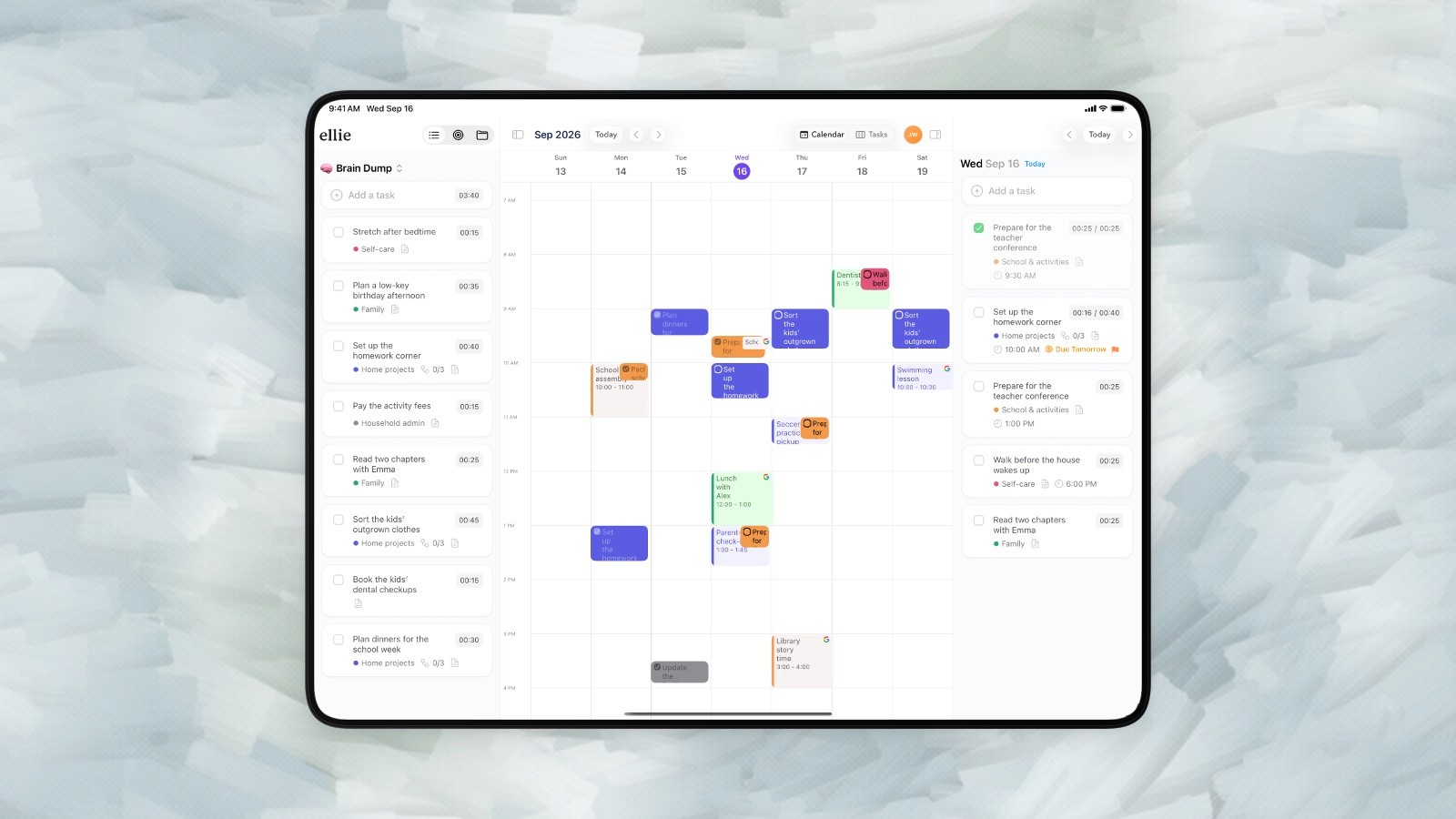
Ellie’s weekly calendar places planned work beside other commitments. This is demo data, not a prescribed study schedule.
Frequently asked questions
Is 25/5 the best Pomodoro schedule for studying?
It is a useful default, especially for starting or bounded practice. Longer synthesis and problem-solving often benefit from 40-to-55-minute sessions. Test one activity rather than applying one interval to an entire course.
What should I do in the five-minute study break?
Leave the material visible, write the exact restart point, then change posture and visual distance. Avoid beginning a new information stream.
Can I listen to music?
If music reliably supports you and does not compete with verbal processing, keep it predictable. Lyrics may interfere more during reading and writing than during routine practice. Compare output rather than relying only on preference.
How many Pomodoros should a student do?
Plan from available time and recovery needs. A class-heavy day may support two focused sprints; an open study day may support several blocks separated by longer breaks. Session count is not a measure of worth or mastery.
Sources
Dunlosky et al., “Improving Students’ Learning With Effective Learning Techniques”, Psychological Science in the Public Interest (2013).
Roediger and Karpicke, “Test-Enhanced Learning”, Psychological Science (2006).
Biwer et al., “Understanding effort regulation”, British Journal of Educational Psychology (2023).
Plan a day that can breathe
Ellie keeps tasks beside your calendar, so you can see your real capacity before the day fills up.
