

A good Pomodoro break reduces the kind of strain your last work interval created without opening a new loop that is hard to close. In five minutes, stand up, change visual distance, drink water, breathe, or do one tiny physical reset. Avoid activities designed to keep you scrolling, arguing, shopping, or solving a second problem.
Pick the break by what feels depleted
The word “break” hides several different needs. You may need relief for your eyes, posture, working memory, emotion, or simple boredom. The most restorative option is usually different from the work you just did.
Use this quick diagnosis:
Eyes feel fixed or dry: look outside or across the room; blink slowly; leave the screen.
Body feels compressed: stand, walk, stretch gently, or refill water.
Mind feels crowded: write the unresolved thought, then look at something undemanding.
Emotion feels activated: slow your exhale, change rooms, or take a brief quiet walk.
Boredom is rising: add movement, light, or a small sensory change rather than more internet novelty.
The goal is not to optimize every second. It is to return with less friction than you left with.
What research actually says about micro-breaks
A 2022 meta-analysis combined 22 independent study samples with 2,335 participants. Micro-breaks of 10 minutes or less had small positive effects on vigor and fatigue. The overall performance effect was not statistically significant, although less cognitively demanding tasks showed more benefit and longer breaks were associated with better performance recovery.
That supports two practical conclusions:
Short breaks are valuable even when they do not create an immediate output spike.
Five minutes may be too little after highly demanding work.
The study did not identify one perfect break activity or duration. Treat a five-minute break as micro-recovery, not a full reset.
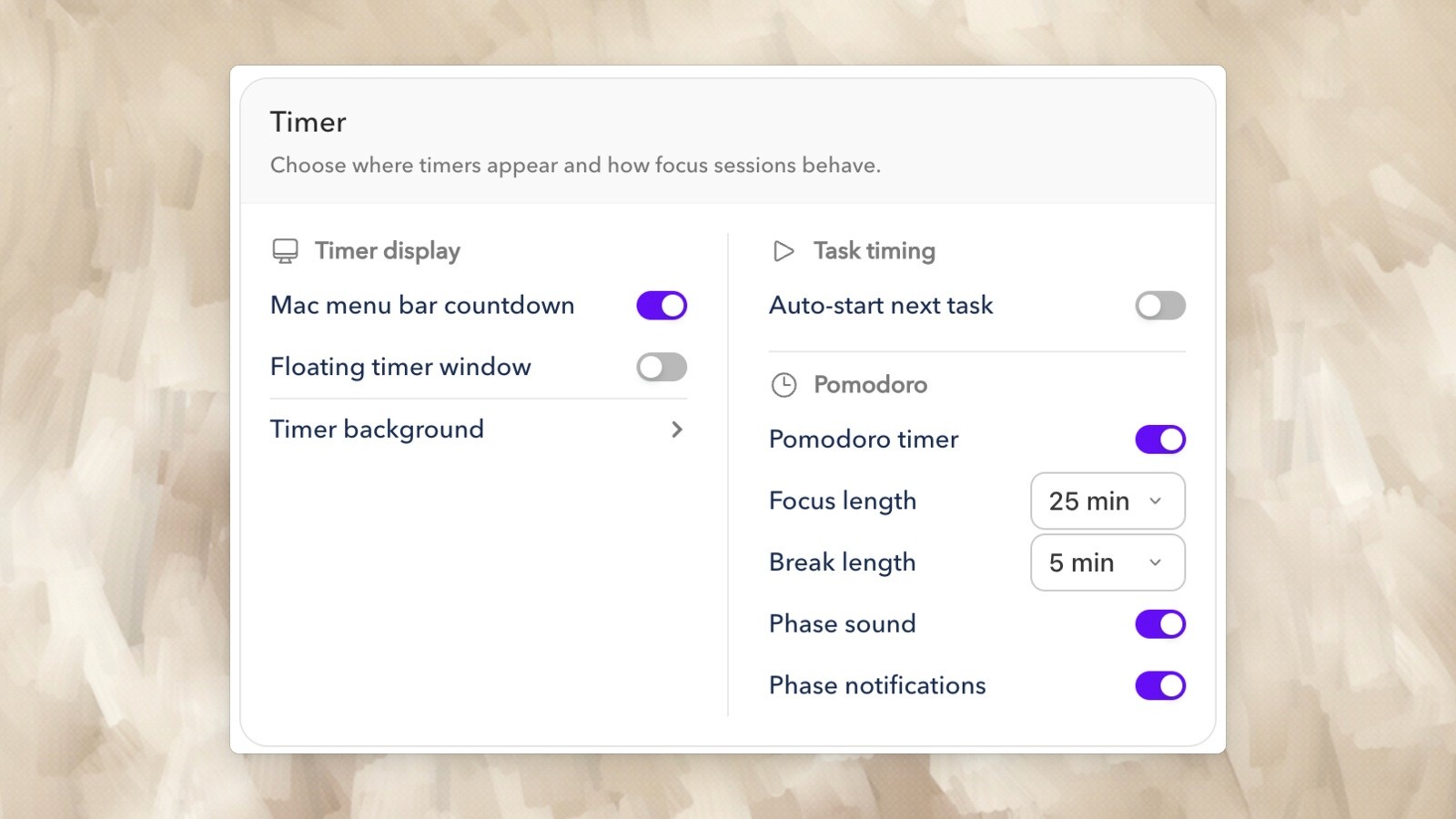
Ellie’s desktop timer has separate focus and break lengths. Choose a break activity before the timer ends.
A five-minute break menu
Choose one item before the focus session starts. Preselecting the break removes the dangerous question, “What should I do now?” while a distracting device is within reach.
For your body
Walk to another room and back.
Do five slow shoulder rolls and open your hands.
Refill water.
Stand near a window.
Change sitting position and adjust the desk.
Movement does not need to become a workout. The purpose is to stop repeating the same physical demand.
For your eyes
Look at a distant object for part of the break.
Close your eyes briefly if that feels comfortable.
Step into different lighting.
Clean your glasses.
Let the screen stay behind you.
Do not replace a laptop at 50 centimeters with a phone at 25 centimeters and call it visual recovery.
For a crowded mind
Write one sentence: “I stopped at ___; next I will ___.”
Put stray thoughts on a capture list.
Breathe quietly without adding a guided audio session.
Look at a plant, window, or uncomplicated physical space.
Put away the materials from the completed subtask.
The closure sentence is especially useful when the timer interrupts meaningful work. It reduces the cost of returning.
For low energy
Get brighter light if possible.
Move briskly for one or two minutes.
Eat a planned snack during a longer break, not absent-mindedly at the desk.
Wash your face or step outdoors.
Decide whether fatigue requires a longer break rather than another sprint.
Breaks should reveal capacity, not help you conceal exhaustion from yourself.
What usually goes wrong
The break becomes a new feed
Social apps, news, short-form video, and online shopping are not morally bad. They are simply engineered without a natural five-minute ending. Opening one creates fresh questions, emotions, and cues that compete with your return.
If you want a phone break, make the boundary physical: stand away from the workstation, use a timer you can hear, and open one predetermined item rather than a feed.
The break becomes more work
Checking email, rearranging the task manager, and “quickly” researching the next step keep the same goal system active. You have switched tasks, but you have not recovered.
Administrative work can be its own Pomodoro. It should not automatically colonize every break.
The break is too passive for the fatigue
Remaining in the same posture while staring at the same display may provide less contrast than your body needs. When the work is sedentary, start with a physical change.
The break has no return cue
A break can feel endless when the next step is vague. Before leaving, write a restart instruction small enough to act on:
Reopen paragraph three and replace the example.
That is easier to resume than “continue writing.”
When to take a longer break
After three or four focus sessions, or after one unusually demanding block, take 15 to 30 minutes when the day permits it.
A longer break can include:
a meal without work on the same screen
a walk outside
a shower
a short conversation that is not about the task
light exercise
quiet rest
Use a longer break when the five-minute pause does not change fatigue, when errors rise, or when you cannot describe the next action. Continuing may produce motion without useful work.
Build a personal break ladder
Create three levels:
Two-minute reset: stand, distance vision, water.
Five-to-ten-minute reset: walk, stretch, snack, or quiet.
Fifteen-to-thirty-minute recovery: food, outside time, movement, or true disengagement.
Then match the level to the session. This is more reliable than using the same five-minute ritual after proofreading and after a difficult conflict.
You can pair the ladder with the interval test in Best Pomodoro Length. Shorter work does not always require a shorter break, and longer work does not always require the maximum break. Demand matters.
Example: four breaks in one afternoon
Jordan plans four sessions:
After 25 minutes of expense entry, Jordan walks to refill water.
After 50 minutes of writing, Jordan records the next sentence and looks outside.
After 20 minutes of difficult calls, Jordan takes 10 quiet minutes instead of forcing the usual five.
After another writing session, Jordan eats away from the desk and returns 25 minutes later.
The breaks are inconsistent by the clock but consistent by purpose: each reduces the demand that accumulated.
Frequently asked questions
Can I use my phone during a Pomodoro break?
Yes, but choose a bounded action: reply to one expected message, play one song, or view one saved item. Feeds and inboxes are risky because they create variable stopping points.
Is doing chores a good break?
A tiny physical chore can be useful if it ends naturally: move laundry, rinse a cup, or water one plant. Avoid chores that expose ten more decisions and make the return feel irresponsible.
Should I meditate during every break?
Only if it is genuinely easy and restorative for you. Turning every break into a self-improvement assignment can make rest feel like another performance.
What if I do not want a break when the timer rings?
Use the signal as a checkpoint. Finish a nearby natural boundary or extend once, then take a proportionate break. Repeatedly skipping breaks is evidence that the interval may be too short.
Sources
Albulescu et al., “Give me a break!” A systematic review and meta-analysis on the efficacy of micro-breaks, PLOS ONE (2022).
Biwer et al., “Understanding effort regulation: Comparing ‘Pomodoro’ breaks and self-regulated breaks”, British Journal of Educational Psychology (2023).
Plan a day that can breathe
Ellie keeps tasks beside your calendar, so you can see your real capacity before the day fills up.
