

Pomodoro can be useful for ADHD when it makes time and restarting more visible. It is not an ADHD treatment and the classic 25/5 schedule is not mandatory. Start with a short, believable interval; make the first action physical and specific; protect the break from becoming an exit; and use a no-shame restart rule when attention moves.
A more flexible version
Use five parts:
Visible start: put the timer where you can see time passing.
Tiny launch action: name the first movement, not the whole project.
Flexible sprint: choose 10, 15, 25, or 40 minutes based on today’s friction.
Return cue: leave one sentence that tells you exactly how to resume.
Neutral restart: when you drift, restart from the next action without “making up” failed time.
This version treats the timer as external scaffolding. It does not turn distraction into a character verdict.
What the evidence can and cannot support
A systematic review and meta-analysis has found measurable differences in time perception between people with and without ADHD across the lifespan, although time perception is complex and studies use different tasks. Reviews of adult ADHD also describe inconsistency across timing measures and individuals.
That makes external clocks, cues, and shorter horizons plausible supports. It does not prove that Pomodoro specifically improves ADHD symptoms. Direct research on Pomodoro is still mostly conducted in student learning contexts rather than as an ADHD intervention.
Use it as a low-risk planning experiment, not a substitute for clinical care, accommodations, medication discussions, sleep, or other supports. If timers increase anxiety, compulsive tracking, or distress, stop and choose a gentler cue.
Start with the friction, not the ideal duration
Ask, “What promise can I believe right now?”
Ten minutes: opening a task with high resistance.
Fifteen minutes: a small admin task or low-energy restart.
Twenty-five minutes: a default focus session with a nearby checkpoint.
Forty minutes: work that becomes easier once a mental model is loaded.
If 25 minutes feels impossibly long, the correct adjustment is not more self-criticism. Use ten. A completed ten-minute start creates information: perhaps the task was easier than predicted, perhaps it needs clarification, or perhaps the energy is not available today.
Make the first action observable
“Work on taxes” asks your brain to navigate an entire project.
Replace it with:
open last year’s tax folder
find the first missing document
write the three questions for the accountant
put the receipts into one physical pile
The first action should be visible enough that another person could tell whether it happened. Once movement begins, the rest of the sprint can expand.
Protect the break from accidental disappearance
Many people describe a five-minute phone break becoming much longer. The problem is not a lack of caring; the break has weak boundaries and the phone offers endless next cues.
Try a closed-loop break:
stand and stretch
refill water
step outside for one lap
play one song
pet an animal
make tea without opening another task
Before leaving, write:
When the timer rings, I will sit down and open the highlighted paragraph.
That combines a return cue with an implementation intention. More break ideas are in What to Do During Pomodoro Breaks.
Use a restart rule instead of a failure rule
Classic descriptions sometimes say an interrupted Pomodoro does not count. That can be clarifying for tracking, but it can also make one distraction feel like a ruined session.
Use this rule:
If I notice I have left the task, I capture what pulled me away and resume at the next visible action. I only restart the timer if the interruption materially changed the session.
Examples:
You looked at a message for 20 seconds: return without resetting.
You answered a five-minute call: write the next action and restart.
A family need changed the next hour: stop the sprint and replan.
The method should make recovery faster. It should not manufacture more failure events.
Add an interest bridge
Some tasks are difficult because their reward is distant or abstract. An interest bridge adds immediate structure without pretending the task is fun.
Options:
race a personal baseline, not another person
use a pleasant location only for this task
work beside someone quietly
pair routine work with instrumental music
use a visual progress marker
plan a real reward after a complete block, not after every minute
Do not add stimulation that competes with the work. A podcast may pair well with laundry and poorly with writing.
Example: beginning an application
Eli has delayed a scholarship application for two weeks. “Finish application” feels large, uncertain, and emotionally loaded.
Eli creates a 15-minute sprint:
Open the application.
Copy every required field into a checklist.
Mark which answers already exist.
At 15 minutes, the application is not finished. But the invisible project has become six visible actions. Eli takes a five-minute walk, returns to “paste the existing transcript,” and starts a 25-minute sprint.
The first timer succeeded because it converted ambiguity into a map.
Put timers inside the real day
A list of eight timers can hide the same overplanning as a list of eight tasks. Place focus sessions beside appointments, meals, transportation, care responsibilities, and recovery.
If the calendar has one open 35-minute window, do not plan a 50-minute sprint and call the later collision a motivation problem. Use Best Pomodoro Length to fit the interval to the work and the window.
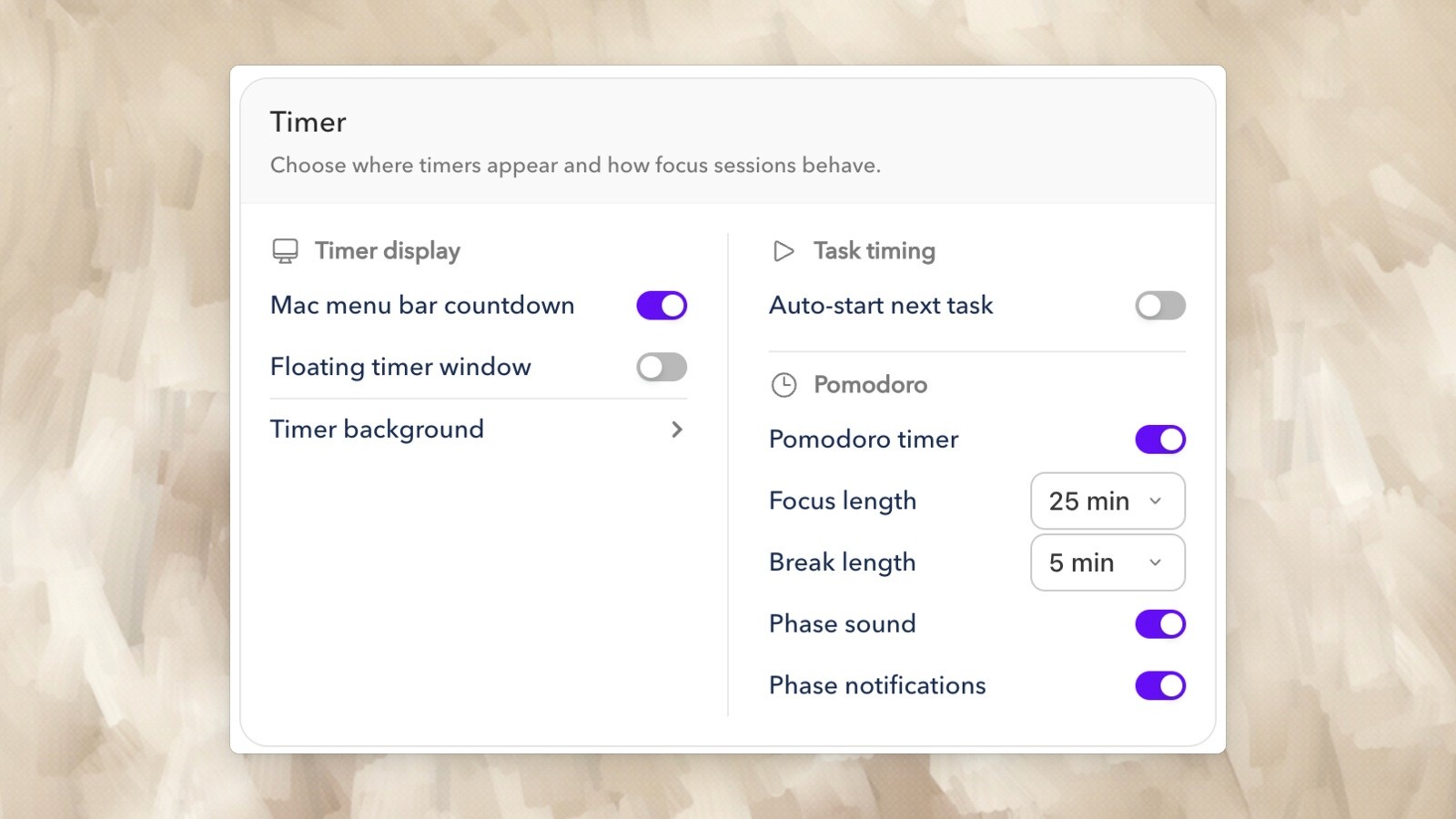
Adjustable focus and break lengths in Ellie’s desktop timer. The settings are a planning aid, not an ADHD treatment.
When Pomodoro may be the wrong tool
The timer sound produces anxiety or hypervigilance.
You are already in stable focus and the signal repeatedly breaks it.
Tracking sessions becomes more important than doing the work.
The task is too ambiguous to define a first action.
Your day is dominated by immediate external demands.
You need rest, food, medication support, or clinical help rather than another productivity technique.
Try a visual time block, a checklist with only the next action, body doubling, or a simple start alarm instead.
Frequently asked questions
What Pomodoro length is best for ADHD?
There is no established ADHD-specific optimum. Start with the shortest interval that feels believable and still permits meaningful progress. Ten, 15, and 25 minutes are all reasonable experiments.
Should I use a physical timer?
A physical or always-visible timer can reduce the risk of opening a phone and encountering unrelated cues. Use whichever tool makes elapsed time visible without adding friction.
What if I hyperfocus past the timer?
Treat the signal as a body-and-priority check. Ask whether continuing is still intentional, whether another commitment is approaching, and whether you need food, water, movement, or medication. You do not have to stop mid-thought, but you should notice the choice.
Is Pomodoro an ADHD treatment?
No. It is a time-structuring technique. It may be a useful support for some people, but it is not diagnostic care or a replacement for evidence-based treatment.
Sources
Zhang et al., “Time-Perception Deficits in Attention-Deficit/Hyperactivity Disorder: A Systematic Review and Meta-Analysis”, Developmental Neuropsychology (2023).
Marx et al., “Time Perception in Adult ADHD: Findings from a Decade—A Review”, International Journal of Environmental Research and Public Health (2023).
Biwer et al., “Understanding effort regulation”, British Journal of Educational Psychology (2023).
Plan a day that can breathe
Ellie keeps tasks beside your calendar, so you can see your real capacity before the day fills up.
