

The Ivy Lee method is a simple daily sequence: at the end of the day, list six important tasks for tomorrow, rank them, and work in order without adding more until capacity appears. The useful idea is serial priority. The famous story that Charles M. Schwab paid Ivy Lee $25,000 for the advice is widely repeated but difficult to verify from a clear contemporary primary record.
The six steps
At the end of the day, write no more than six important tasks for tomorrow.
Rank them by true importance.
Begin with task one.
Work until it is complete or reaches a valid stopping point.
Move to the next task.
Carry unfinished work forward only after reconsidering it.
The method removes repeated priority decisions during the day. Its weakness is that six tasks can still represent six hours or six weeks.
What is documented, and what is story
Ivy Ledbetter Lee was a major early public-relations figure and worked with Bethlehem Steel. Archival records document that professional relationship.
The productivity anecdote says Lee gave Charles M. Schwab the six-task method and asked him to pay whatever it proved worth; Schwab later sent $25,000. The story became popular through later business and self-help retellings. Modern accounts often present the amount, date, and result with more certainty than the accessible historical record supports.
You do not need the anecdote to use the method. Treat it as a famous reported origin story, not experimental evidence.
Add the missing capacity check
Before ranking, estimate each task:
S: under 20 minutes
M: 20–60 minutes
L: 60–120 minutes
P: several sessions or a project
Then compare with the open calendar.
A realistic six might be:
one L
two M
three S
An unrealistic six might be:
four P
two L
Both lists contain six lines. Only one can guide a day.
Define “complete enough”
“Work until complete” can trap you in one expandable task.
Before beginning, write the stopping condition:
draft contains every section
decision memo recommends one option
ten records are reconciled
test reproduces or rules out the suspected cause
room is safe and usable
If the work cannot be completed today, define a checkpoint and treat the project as several ranked tasks across days.
Rank by consequence, not discomfort
The most uncomfortable task can feel most important because it occupies attention.
Use:
fixed consequence
commitment to another person
dependency that blocks later work
meaningful progress
maintenance
Then check whether the rank fits your energy and environment. A difficult writing task may be priority one but still belong after school drop-off rather than at 6:00 a.m.
Example: a six-task plan
Dana’s original list:
finish website
email
taxes
exercise
groceries
clean house
Every item is a category.
Rewritten:
Approve homepage copy and mobile layout, 75 minutes.
Gather tax documents and list missing items, 30 minutes.
Send the three replies blocking other people, 20 minutes.
Walk for 25 minutes after lunch.
Buy the five dinner essentials, 25 minutes plus travel.
Clear and wipe the kitchen counters, 15 minutes.
Now the list can be compared with the calendar.
Use a blocker rule
The original serial idea can stall when task one depends on someone else.
Use:
If the next action cannot proceed within ten minutes, record the blocker, send the request, and move to the next ranked task that is actually executable.
Do not abandon priority one silently. Create a follow-up cue.
Use a stopping rule for the day
The list is not a moral contract to finish all six.
Stop when:
the planned capacity ends
a fixed responsibility begins
quality has meaningfully declined
health or recovery needs take priority
Move unfinished items only after asking whether they remain important. Automatic rollover can preserve a bad task forever.
Compare Ivy Lee with MIT planning
The Most Important Tasks method chooses one to three defining outcomes. Ivy Lee adds a longer ordered queue.
Use MIT when the day is volatile or capacity is low. Use Ivy Lee when you want a simple order across several executable tasks. Combine them by making task one the primary MIT and treating tasks two through six as a queue, not promises.
Put the queue beside the day
In Ellie, order the six tasks, then schedule only the first one or two into actual open windows. The rest remain ranked but unscheduled. If the first task overruns, the list still shows what loses capacity.
This preserves serial priority without turning six tasks into calendar fiction.
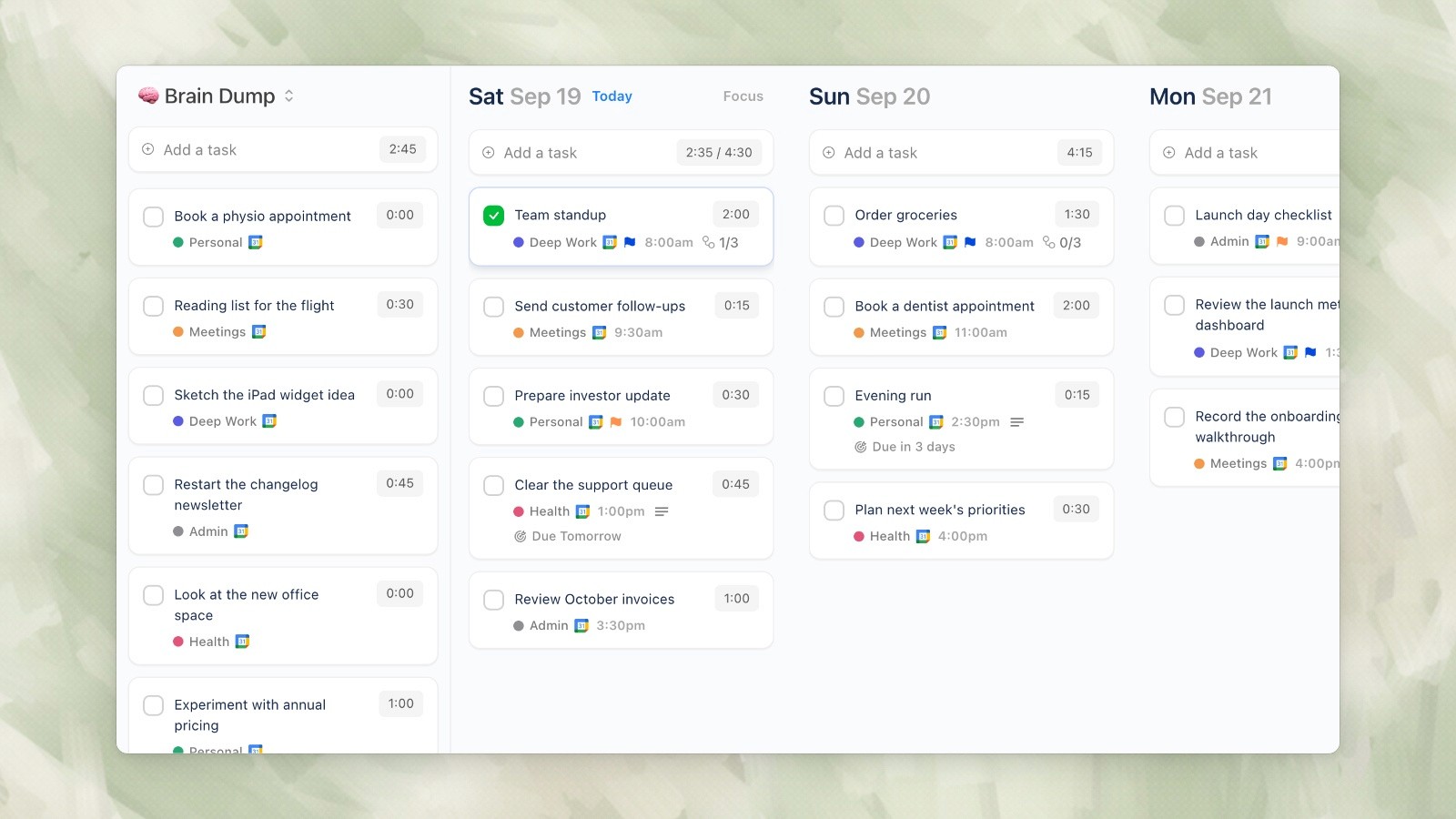
Ellie separates the larger backlog from the tasks selected for a day. This demo illustrates the two lists, not an exact six-task prescription.
Common mistakes
Treating the historical payment story as proof of effectiveness.
Choosing six projects.
Ranking before checking deadlines and dependencies.
Refusing to move past a blocked task.
Polishing task one all day.
Adding new tasks above the list without re-ranking.
Assuming unfinished items automatically belong tomorrow.
Frequently asked questions
Did Charles Schwab really pay Ivy Lee $25,000?
The story is widely repeated, and Lee’s work with Bethlehem Steel is documented. The exact productivity anecdote is difficult to confirm from a clear contemporary primary source, so it is best described as reported rather than proven.
Why six tasks?
Six creates a bounded queue, but there is no research establishing six as optimal. Use fewer when tasks are large or the day has limited capacity.
Must I finish task one before task two?
Stay with task one while productive action is possible. If it is blocked, reaches a planned checkpoint, or no longer deserves the time, record the state and re-rank deliberately.
Should I write the list at night?
Writing it before the day can reduce morning decisions. If your schedule changes overnight or varies heavily, do a brief morning confirmation.
Sources
Princeton University Library, Ivy Ledbetter Lee Papers finding aid, documenting Lee’s professional work, including Bethlehem Steel records.
Lehigh Valley Press, historical account of Ivy Lee and Bethlehem Steel, which describes the productivity meeting as a story repeated over time.
Harvard Business School, Charles M. Schwab profile, for company and leadership context.
Plan a day that can breathe
Ellie keeps tasks beside your calendar, so you can see your real capacity before the day fills up.
