

Body doubling means doing a task while another person is present, either physically or virtually, without requiring that person to help with the task. Many people with ADHD report that the shared presence makes starting or staying with work easier. Direct research on body doubling itself remains limited, so treat it as a low-pressure personal experiment, not an established ADHD treatment.
What a body double does
A body double may provide:
a visible start
gentle social accountability
fewer opportunities to disappear into another task
a shared work rhythm
help returning after distraction
reduced isolation during unpleasant work
The other person does not need to supervise, coach, or understand the project. They can work on something entirely different.
What the evidence says
The Attention Deficit Disorder Association describes body doubling as a commonly reported strategy while explicitly noting the lack of research proving its effectiveness.
Recent exploratory work has begun to study virtual and simulated co-presence, including small studies and preprints. That is early evidence, not a mature clinical literature. It does not establish who benefits, the size of the effect, or whether any benefit is specific to ADHD.
This distinction is important because many online articles turn community experience into confident neuroscience. A reasonable position is:
the strategy is plausible
many people find it useful
direct evidence is still thin
the personal cost of a careful trial can be low
Run a four-session test
Compare similar tasks, not one easy day with one hard day.
Session 1: alone
Record:
minutes until start
useful work completed
number of major departures
stress before and after
Session 2: silent virtual partner
Agree on start and stop. Share only the task outcome if comfortable.
Session 3: in-person or camera-optional coworking
Use the format that feels safest. The test is co-presence, not surveillance.
Session 4: alone again
Repeat a similar task to see whether novelty drove the difference.
After four sessions, ask whether body doubling improved starts, returns, output, or emotional cost.
Use a simple session script
Opening, two minutes
Each person says:
what I will work on
the first visible action
when we will check out
whether interruption is allowed
Example:
I’m opening the application, listing required documents, and drafting the first answer. Let’s check out in 40 minutes. Message only if something is urgent.
Work
Stay mostly quiet. Use microphones and cameras by agreement. A silent room can be enough.
Closing, three minutes
Each person says:
what moved
next action
whether another session is needed
Do not turn checkout into a performance review.
Match the double to the task
Quiet presence
Best for writing, study, coding, forms, or focused admin.
Parallel movement
Best for cleaning, packing, exercise, or household resets. Video may be unnecessary; a start and finish call can provide the boundary.
Interactive support
Useful when the task needs clarification or emotional support, but this is no longer pure body doubling. Agree on the kind of help.
Public coworking
A library or cafe can provide ambient co-presence without coordination. It is less accountable but easier to arrange.
Make consent and privacy explicit
Agree on:
camera on, optional, or off
whether screens are shared
whether confidential material is visible
whether sessions are recorded
when conversation is welcome
how either person can end the session
Never expose health, financial, legal, customer, school, or workplace information without authorization. Do not use body doubling as covert monitoring.
Example: starting paperwork
Dev has postponed benefits paperwork.
The session:
5 minutes: state task and gather documents
25 minutes: complete known fields
5 minutes: list missing information
5 minutes: checkout and schedule the next action
The body double works quietly on invoices. Dev still feels resistance, but the paperwork remains the default activity for the shared window.
When body doubling backfires
social anxiety becomes the main demand
the partner talks or needs support
comparison creates shame
privacy limits prevent the real task
scheduling the session takes longer than the work
the presence feels controlling
you become unable to start any task alone
Try camera-off coworking, a public workspace, a short start call, or a visible timer instead.
Use it with a timer or calendar
Body doubling answers who is present. A timer answers how long this attempt lasts. The task definition answers what happens.
Combine:
one observable outcome
one shared start
one realistic work interval
one checkout
You can place the session in Ellie beside the rest of the day and attach the meeting link to the task. For a timer structure, see Pomodoro for ADHD.
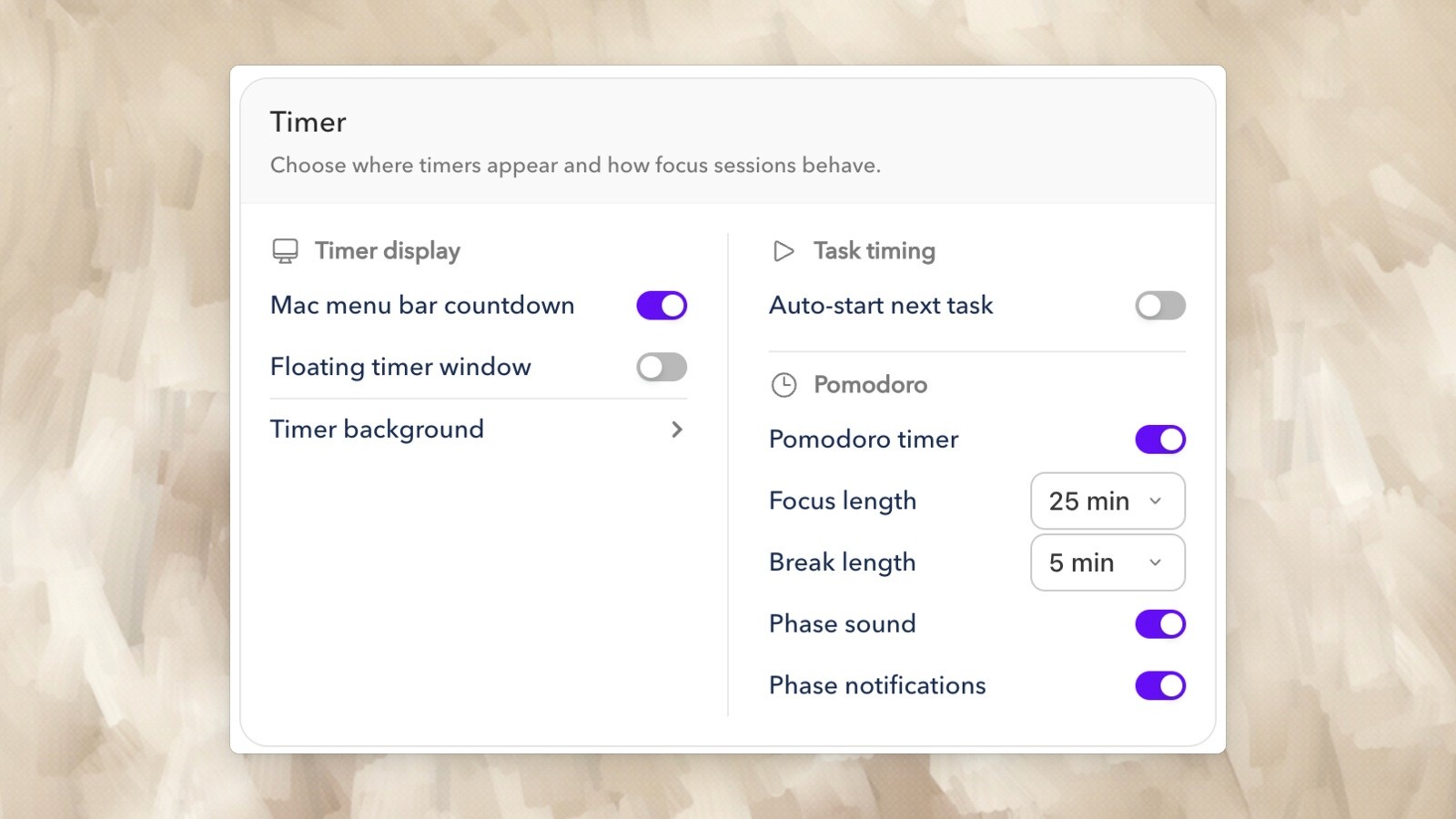
Ellie’s desktop timer supports adjustable focus and break lengths for a planned work session.
When to seek more support
Body doubling is not a substitute for ADHD assessment or treatment. Seek qualified help when attention, impulsivity, missed care, school, work, driving, finances, or distress create significant harm.
Frequently asked questions
Does the body double need to have ADHD?
No. They need to respect the format, privacy, and low-pressure purpose. Shared experience may help communication but is not required.
Must the camera be on?
No. Audio, a text check-in, screen presence, or a shared physical location may be enough. Use the least intrusive format that still helps.
Is virtual body doubling effective?
Many people report benefit, but direct research is limited. Test the format against your own starts and output rather than assuming one platform works.
Is body doubling the same as accountability coaching?
No. A body double provides presence. A coach may teach, plan, monitor, or help solve barriers. Keep expectations clear.
Sources
Attention Deficit Disorder Association, “The Body Double”, a community-oriented explanation that also notes the limited direct research.
Ara et al., exploratory study of VR body doubling (2025 preprint; not peer reviewed).
Tan et al., research roadmap for digital body doubling (2026 preprint; not peer reviewed).
Plan a day that can breathe
Ellie keeps tasks beside your calendar, so you can see your real capacity before the day fills up.
