

Attention residue is the portion of attention that remains attached to a previous task after you switch, especially when that task is unfinished or difficult to put down. You cannot eliminate every switch, but a two-minute closure note can give the open loop a trusted place: record where you stopped, what remains unresolved, and the exact next action.
The two-minute closure note
Before switching, write:
Stopped at: the current location or state.
Unresolved: the question, risk, or missing input.
Next action: one observable movement.
Return trigger: when or under what condition you will resume.
Example:
Stopped at: proposal section 3, after the first example.
Unresolved: whether the customer quote can be public.
Next action: message Dana for permission, then draft a placeholder example.
Return: tomorrow’s 9:00 proposal block.
This is not a summary of the whole project. It is a re-entry ramp.
What the research found
In a series of experiments, organizational researcher Sophie Leroy found that performance on a new task could suffer when people switched away from unfinished work. Part of their attention remained with the prior task, a phenomenon described as attention residue.
Later research by Masicampo and Baumeister found that unfulfilled goals can create intrusive thoughts, while forming a specific plan for completing them can reduce those cognitive effects. A plan does not complete the work, but it may reassure the mind that the goal has a route back.
The practical implication is narrower than “never multitask.” When you must switch, make the previous task easier to trust outside your head.
Why a vague task list is not enough
“Finish proposal” preserves the obligation but not the working state.
When you return, you must reconstruct:
which file
which section
which question
which source
what you had already rejected
what counts as the next unit
A closure note captures the expensive part of the context while it is still available.
Use a state snapshot for complex work
For coding, design, research, or analysis, add:
current hypothesis
last thing tested
evidence that changed your mind
files or tabs that matter
next smallest test
Example:
Hypothesis: the stale list comes from cached client state, not the database.
Last test: clearing the server record did not remove the visible item.
Next test: inspect the merge function after local label removal.
Files: TaskProvider.tsx, mergeWith.ts.
The note prevents tomorrow’s session from repeating today’s discovery.
Close at natural boundaries when possible
Good boundaries:
paragraph complete
test run recorded
message sent
decision written
materials gathered
next question named
If a meeting forces an arbitrary stop, spend the final two minutes creating an artificial boundary. Do not use those two minutes to squeeze in more output.
Use a switch buffer
A closure note captures the cognitive state. A buffer helps your attention and body leave it.
Try:
write the note
close or hide the prior workspace
stand or change visual distance
review the next task’s first action
begin with one small orienting step
See Buffer Time Between Tasks for choosing the size of that gap.
Example: meeting to writing
Amira leaves a product meeting at 10:00 and plans to write at 10:00.
Without closure, she spends the first 20 minutes replaying unresolved decisions and checking chat.
The revised transition:
9:55: meeting owner states decisions and unresolved questions
10:00: Amira writes her follow-up task and owner
10:03: she walks away from the screen
10:10: she opens the article and reads yesterday’s closure note
10:12: writing begins
The calendar “loses” 12 minutes and may gain a much cleaner session.
Example: stopping mid-study
Noah must leave a chemistry problem set for class.
Instead of writing “problem 8 unfinished,” Noah records:
I can calculate initial moles but do not know which reagent is limiting. Next: compare mole-to-coefficient ratios for A and B. Return after class at the library.
The next session begins with a testable operation rather than a feeling of failure.
Make the next action small enough
Weak next actions:
figure out strategy
continue research
finish design
deal with feedback
Strong next actions:
list the three decisions the strategy must make
open source 4 and extract the sample definition
compare the mobile spacing at 390 pixels
group feedback into factual, preference, and scope changes
The more friction a task carries, the more literal the re-entry should be.
Do not over-document routine work
Attention-residue tools can become another delay.
Use closure notes for:
unfinished complex work
interruptions
handoffs
emotionally sticky work
tasks with expensive setup
work that will resume after a long gap
Skip the full template after simple, finished actions. One line is enough when the state is obvious.
Build it into the day
Add a two-to-five-minute close period to focus blocks and meetings. In Ellie, keep the next action on the task and reserve a visible transition before the next calendar commitment.
The closure belongs inside the current block, not as unpaid time borrowed from the next one.
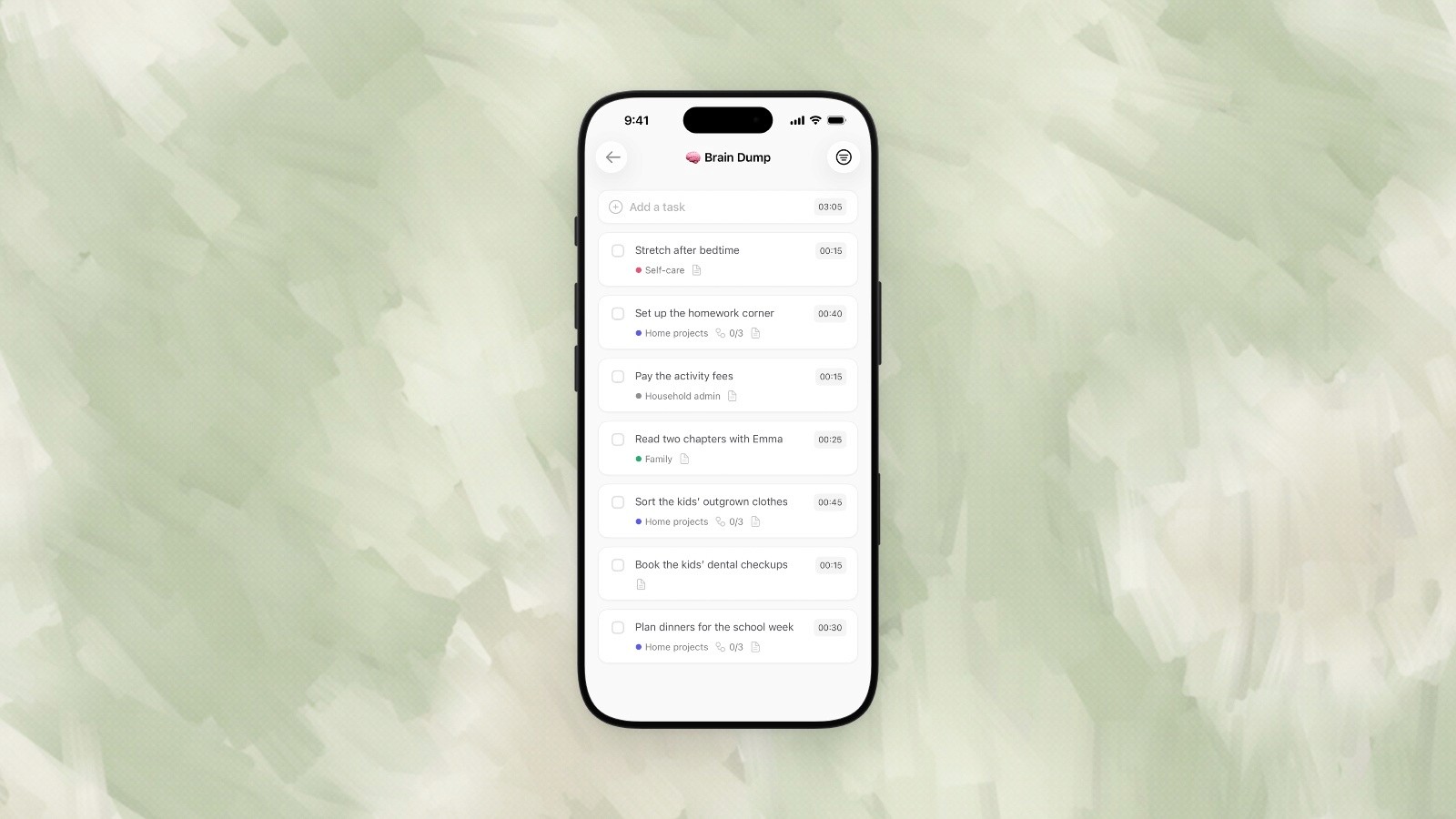
Capture unfinished work in a separate list before choosing what to do next. Ellie Brain Dump, using demo data.
Frequently asked questions
Is attention residue the same as distraction?
No. Distraction is attention pulled toward another stimulus. Attention residue describes part of attention remaining with a prior task after you have switched.
Does finishing the task remove residue?
Completion can help, but “finished” is not always available. A trusted completion plan and clean state record can make an unfinished task easier to leave.
Should I close every tab?
Close unrelated or tempting tabs. Preserve the few that materially support re-entry, ideally in a named tab group, workspace, or note. Forty open tabs are not a reliable memory system.
Can a break reduce attention residue?
A break may help, especially when it changes context, but the unresolved goal can remain active. Capture the open loop before relying on recovery alone.
Sources
Leroy, “Why is it so hard to do my work? The challenge of attention residue when switching between work tasks”, Organizational Behavior and Human Decision Processes (2009).
Masicampo and Baumeister, “Consider It Done! Plan Making Can Eliminate the Cognitive Effects of Unfulfilled Goals”, Journal of Personality and Social Psychology (2011).
Plan a day that can breathe
Ellie keeps tasks beside your calendar, so you can see your real capacity before the day fills up.
