Ellie the hamster dropping a note card into a blue inbox tray, with loose task cards beside it
Ellie the hamster choosing a blue card from a small three-slot card holder
Ellie the hamster sticking a note onto a timebox board
Ellie the hamster turning the page of a small tent calendar, and her task rolls over to the new day

The psychology of the Ellie method

The psychology of the Ellie method

The psychology of the Ellie method

Based on the

Zeigarnik effect

Zeigarnik effect

Zeigarnik effect

THE ZEIGARNIK EFFECT

Unfinished tasks stick in your head.

Unfinished tasks stick in your head.

Unfinished tasks stick in your head.

In 1927, psychologist Bluma Zeigarnik found that people remember unfinished tasks much better than finished ones. Your brain keeps a little reminder running for each one, so it won’t get forgotten. A few are fine. Twenty of them, and your head feels full before you’ve even started.

Ellie the hamster at her laptop with a thought bubble

The Ellie method turns those reminders off, in four steps.

The Ellie method turns those reminders off, in four steps.

The Ellie method turns those reminders off, in four steps.

Here’s what each step does, and why it works.

Ellie the hamster dropping a note card into a blue inbox tray, with loose task cards beside it

1

Write it down

Ellie the hamster choosing a blue card from a small three-slot card holder

2

Pick a few

Ellie the hamster sticking a note onto a timebox board

3

Give it a time

Ellie the hamster turning the page of a small tent calendar, and her task rolls over to the new day

4

Roll with it

STEP 1

Write it down.

Write it down.

Write it down.

HOW IT WORKS

Put every task in the Brain Dump the moment you think of it. No dates, no sorting. Just get it out of your head.

Put every task in the Brain Dump the moment you think of it. No dates, no sorting. Just get it out of your head.

WHY IT WORKS

When a task is written down with a plan, your brain stops reminding you about it. The reminder switches off, and your head feels lighter.

When a task is written down with a plan, your brain stops reminding you about it. The reminder switches off, and your head feels lighter.

Ellie the hamster dropping a note card into a blue inbox tray, with loose task cards beside it

STEP 2

Pick a few for today.

Pick a few for today.

Pick a few for today.

HOW IT WORKS

Choose only what fits in today. Ellie adds up how long each task will take.

Choose only what fits in today. Ellie adds up how long each task will take.

WHY IT WORKS

We all think things take less time than they really do, so we plan days that can’t fit. Seeing the total keeps today realistic.

We all think things take less time than they really do, so we plan days that can’t fit. Seeing the total keeps today realistic.

Ellie the hamster choosing a blue card from a small three-slot card holder

STEP 3

Give each one a time.

Give each one a time.

Give each one a time.

HOW IT WORKS

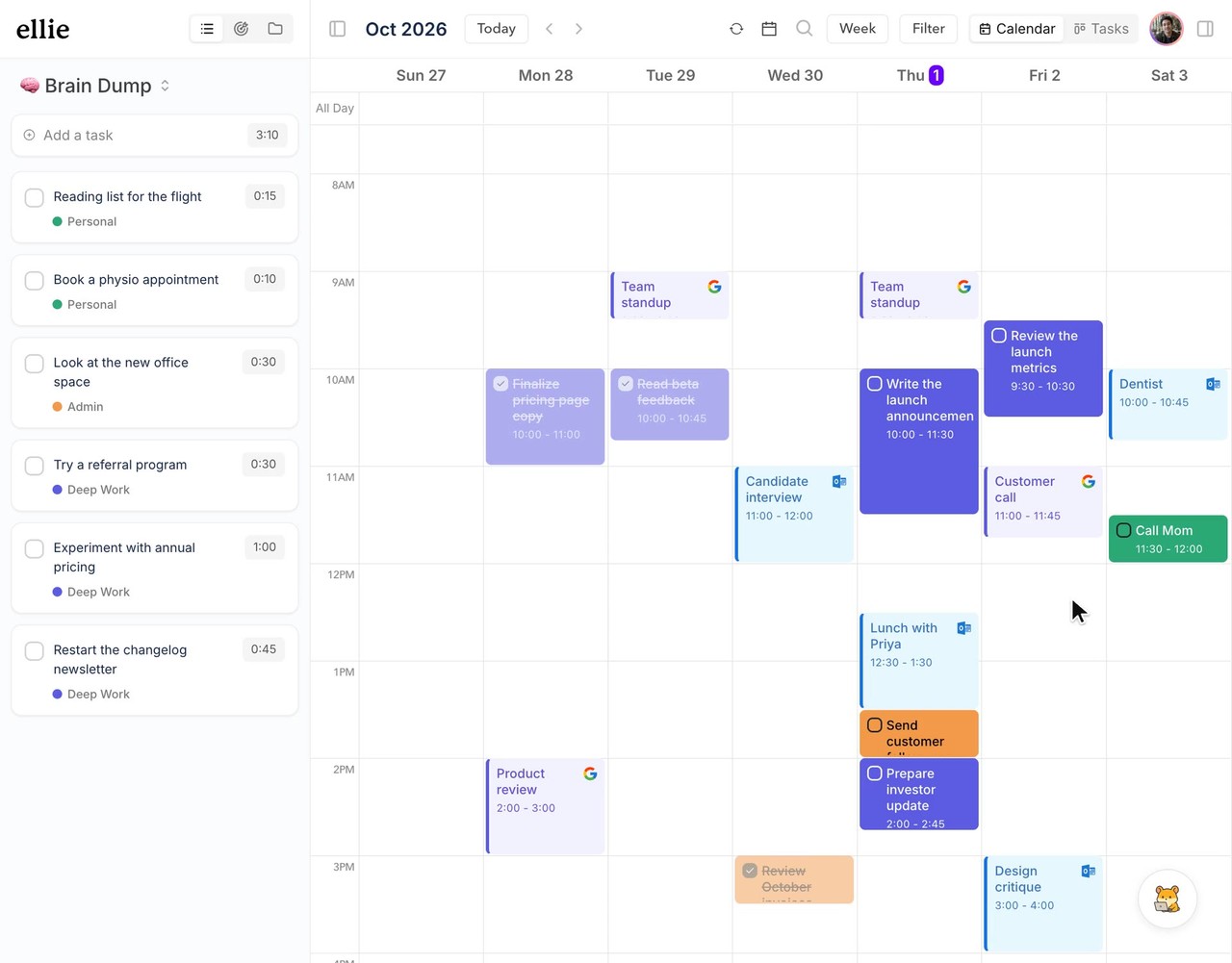
Drag each task onto your calendar, right next to your meetings.

Drag each task onto your calendar, right next to your meetings.

WHY IT WORKS

“Sometime today” is easy to skip. “At 2:00” is a plan your brain is much more likely to keep.

“Sometime today” is easy to skip. “At 2:00” is a plan your brain is much more likely to keep.

Ellie the hamster sticking a note onto a timebox board

STEP 4

Roll with the day.

Roll with the day.

Roll with the day.

HOW IT WORKS

When plans change, just move things. Anything you don’t finish moves to tomorrow on its own.

When plans change, just move things. Anything you don’t finish moves to tomorrow on its own.

WHY IT WORKS

Feeling guilty about falling behind makes you avoid your list. Being kind to yourself makes it easier to start again.

Feeling guilty about falling behind makes you avoid your list. Being kind to yourself makes it easier to start again.

Ellie the hamster turning the page of a small tent calendar, and her task rolls over to the new day

Bonus: it can help you sleep.

Bonus: it can help you sleep.

Bonus: it can help you sleep.

Writing down tomorrow’s tasks before bed means your brain doesn’t have to hold on to them all night.

Ellie the hamster asleep in a gently swaying hammock tied between two big blue forget-me-not flowers

That’s the whole method.

That’s the whole method.

That’s the whole method.

Write it down. Pick a few. Give each one a time. Roll with the day.

THE SCIENCE

The research behind each step

The research behind each step

The research behind each step

Each step is based on real studies. Here’s what they found, in plain words.

THE ZEIGARNIK EFFECT

Unfinished tasks are remembered better.

People were given a series of small tasks and stopped partway through some of them. Later, they remembered the unfinished tasks nearly twice as well as the finished ones.

STEP 1 · WRITE IT DOWN

A plan quiets unfinished tasks.

A plan quiets unfinished tasks.

People with an unfinished goal on their mind kept getting distracted by it. Once they wrote a specific plan for it, the distraction went away, even though the goal wasn’t done yet.

STEP 2 · PICK A FEW

We all guess too low.

We all guess too low.

Students guessed their thesis would take about 34 days. It took about 56. Psychologists call this the planning fallacy, and it happens to most of us.

STEP 3 · GIVE IT A TIME

Deciding when makes you follow through.

Deciding when makes you follow through.

Across 94 tests of this idea, people who decided exactly when and where they’d do something were much more likely to actually do it.

STEP 4 · ROLL WITH IT

Kindness beats guilt.

Kindness beats guilt.

Students who forgave themselves for putting off studying for one exam put things off less before the next one.

BONUS · SLEEP

A to-do list helps you fall asleep.

A to-do list helps you fall asleep.

In a sleep lab, people who spent five minutes writing tomorrow’s to-do list fell asleep about nine minutes faster than people who wrote about what they’d already done.

These studies didn’t test Ellie itself. They explain the ideas the Ellie method is built on.