

Task batching means grouping work that shares a setup, tool, place, person, or energy mode so you pay the transition cost fewer times. Batch invoices, calls, errands in one area, or photo edits with the same setup. Do not batch difficult tasks merely because they share a label; uncertainty and emotional load can make a neat batch exhausting.
The real unit is setup
“Batch all writing” sounds organized but may combine:
a personal apology
product documentation
a social caption
a grant application
The keyboard is the same. The mental setup is not.
A useful batch shares one or more of these:
Tool: same application, equipment, or files
Place: same store, room, route, or person
Mode: same kind of attention or decision
Energy: similar cognitive or emotional demand
Latency: work that benefits from one send-and-wait cycle
Cleanup: materials that are expensive to set up and put away
The more setup a group shares, the more batching can save.
Good batching candidates
Communication with a bounded scope
reply to routine messages
return calls
send scheduling confirmations
review comments on one project
Keep urgent and emotionally difficult communication out if it needs preparation or recovery.
Physical errands by route
pharmacy, grocery, and post office in one area
returns to stores in the same center
household tasks using the same tools
Route batching saves travel but can create an unrealistic marathon. Include opening hours, lines, carrying capacity, and food.
Repeated production
resize a set of images
enter receipts
scan documents
photograph several products with one lighting setup
prep ingredients that use the same station
The repeated action should be stable enough that the first setup benefits the rest.
Small administrative decisions
approve routine requests
reconcile known transactions
schedule appointments
update recurring records
Create a rule before the batch so each item does not reopen the whole policy.
Bad batching candidates
Work that only looks similar
“Write six things” may require six audiences, tones, sources, and emotional states. The context changes even if the verb does not.
High-uncertainty work
Three unfamiliar technical problems do not become cheaper because they are placed together. Each may need discovery, and one can consume the entire block.
Emotionally heavy work
Stacking performance reviews, difficult calls, medical paperwork, and conflict messages may reduce recovery exactly when it is needed.
Work with different energy demands
Do not bury your hardest reasoning task inside a long batch of easy admin. The routine items can create the feeling of progress while consuming the energy reserved for the important one.
Tasks that benefit from spacing
Learning, editing, and decisions sometimes improve with time between attempts. Batch the setup, not every stage. Draft several outlines, then review them later.
The four-question batch test
Before grouping tasks, ask:
What setup will I avoid repeating?
Will the same decision rule apply?
Does item ten remain useful after item nine?
What is the stopping boundary?
If you cannot name the saved setup, the batch may be aesthetic rather than efficient.
Use batch caps
Batches expand because every similar item appears to belong.
Choose a cap:
time: 30 minutes
count: ten messages
route: three stops
outcome: all receipts from June
energy: stop after one difficult call
At the cap, reassess. Do not let low-value similarity crowd out the rest of the day.
Add a “do not batch” marker
Some items deserve individual space. Mark them:
requires a decision
emotionally difficult
needs uninterrupted focus
depends on missing information
has a hard deadline
must be reviewed for safety or accuracy
This prevents a special case from hiding in routine work.
Example: a useful communication batch
Lee has 28 messages.
Instead of “clear inbox,” Lee creates three groups:
Routine replies: scheduling, confirmations, known answers.
Decision replies: messages requiring a choice or research.
Sensitive replies: conflict, feedback, or personal stakes.
Lee timeboxes routine replies for 25 minutes. Decision replies become individual tasks with needed information. One sensitive reply gets a protected 30-minute block and a buffer afterward.
The inbox remains nonzero, but the batch has done the work it was suited to do.
Example: batching household work by state
“Do chores” creates an exhausting mixed list.
Batch instead by state:
while laundry runs: clear one surface and prepare the next load
while outside: trash, mail, and one nearby errand
while the kitchen is wet: dishes, sink, and counters
while energy is low: fold, sort, and restock
The batch follows materials and energy rather than room labels.
Batching and attention residue
Switching research suggests that unfinished work can leave part of attention attached to the prior task. Batching can reduce the number of switches, but it can also create many unfinished items if you hop within the batch.
Finish a meaningful unit before moving to the next item. When one remains open, use a two-minute closure note:
where I stopped
what is unresolved
exact next action
Put batches on a realistic calendar
Create a task for the batch and keep the individual items in a checklist or filtered list. Put the batch into one calendar window with a cap.
In Ellie, you can keep the underlying tasks visible while protecting one communication, errands, or admin window beside appointments. Do not distribute every small item into its own calendar block.
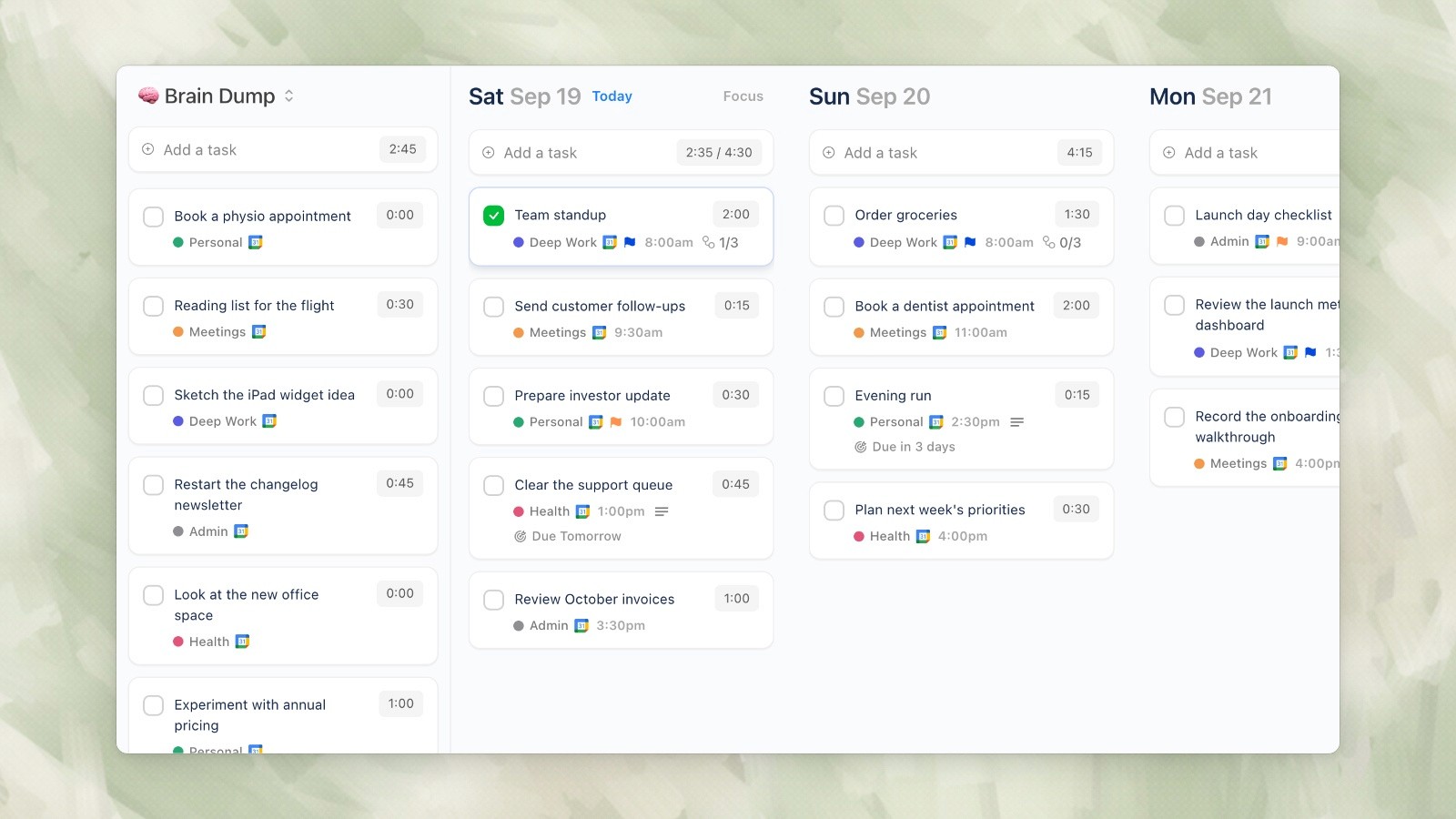
Keep the underlying tasks visible while deciding which work belongs in today’s plan. Ellie desktop demo.
When task batching is not helping
output quality falls across the batch
the last items take much longer than the first
the batch is repeatedly avoided
sensitive work gets rushed
one blocker stops the whole group
you finish “busy” but miss the important outcome
Split by demand, shorten the batch, or move the highest-consequence item outside it.
Frequently asked questions
Is task batching the same as time blocking?
No. Batching decides which tasks belong together. Time blocking decides when a batch or task receives calendar space. They work well together.
How long should a task batch be?
Start with 20 to 45 minutes for routine desk work. Use shorter caps for unpleasant or high-volume items and longer blocks only when setup is expensive and quality remains stable.
Should I batch email?
Batch routine email when constant checking fragments other work. Separate messages that require research, judgment, or emotional care.
Can I batch creative work?
Batch stages with shared setup: generate ideas together, photograph with one lighting setup, or edit in one pass. Avoid forcing all creative decisions into one fatigued session.
Sources
Leroy, “Why is it so hard to do my work?”, research on attention residue after task switching (2009).
Rubinstein, Meyer, and Evans, “Executive Control of Cognitive Processes in Task Switching”, Journal of Experimental Psychology (2001).
Plan a day that can breathe
Ellie keeps tasks beside your calendar, so you can see your real capacity before the day fills up.
