

Choose Pomodoro when you need help starting, pacing, or remembering breaks. Choose Flowtime when you can start but fixed alarms repeatedly interrupt useful momentum. A practical hybrid is often better: use a short minimum commitment to begin, then let the session continue until a natural stopping point while recording the actual focus and break times.
The difference at a glance
Stopping point: Pomodoro stops at a preset interval or checkpoint. Flowtime stops at a natural boundary, meaningful fatigue, or distraction.
Break timing: Pomodoro schedules the break in advance. Flowtime chooses the break after the focus period.
Main strength: Pomodoro creates structure and a near-term finish. Flowtime protects momentum and adapts to the task.
Main risk: A Pomodoro alarm can interrupt a useful mental model. A Flowtime session can stretch into fatigue or avoidance.
Best fit: Pomodoro is useful for starting friction, routine work, and study structure. Flowtime suits immersive work, variable tasks, and people who can already begin.
Neither method measures the quality of attention by itself. Both can become sophisticated ways to sit with the wrong task.
How Pomodoro works
The classic pattern is:
Choose one task.
Work for 25 minutes.
Take a five-minute break.
After several sessions, take a longer break.
Its hidden advantage is decision reduction. You do not repeatedly ask whether to keep working, whether you have done enough, or whether a break is deserved. The next boundary is already visible.
Research with university students has found that systematic break schedules can produce better subjective concentration, motivation, and fatigue patterns than completely self-regulated breaks. That is evidence for structure, not proof that every person or task should stop at 25 minutes.
How Flowtime works
Flowtime keeps the single-task and tracking parts while removing the fixed stopping time:
Write the task and start time.
Work until you naturally stop, become meaningfully distracted, or notice fatigue.
Record the stop time.
Take a break that reflects the length and demand of the session.
Record the restart and repeat.
The log helps you observe focus rather than prescribe it. Over time, you can see which tasks invite 18 minutes, 47 minutes, or 82 minutes of useful work.
The limitation is obvious: “work until I feel like stopping” requires noticing internal signals and distinguishing fatigue from ordinary resistance. That is not equally easy on every day.
What comparative research suggests
Direct evidence comparing Pomodoro and Flowtime is still limited. A recent exploratory study of students compared self-regulated, Pomodoro, and Flowtime break patterns. The methods did not produce a simple universal winner across motivation, productivity, and fatigue. Another student comparison reported that more participants preferred Pomodoro’s structure, while Flowtime appealed to those who valued immersion.
These studies are useful but not definitive. Student samples, short study sessions, self-reported outcomes, and relatively new comparisons cannot tell us the best method for every kind of work.
The honest conclusion is task-specific: structure helps when self-regulation is expensive; flexibility helps when fixed interruption is expensive.
Use the start-versus-sustain test
Ask two questions.
Is starting the main problem?
Signs:
you delay because the task feels endless
you keep preparing instead of beginning
you need an external cue
you want a nearby permission to stop
Start with Pomodoro, possibly shorter than 25 minutes.
Is sustaining the main problem?
Signs:
you begin easily but resent the alarm
the work takes time to load into memory
natural subtask boundaries are unpredictable
a restart costs more than a few minutes
Try Flowtime.
If both are problems, use the hybrid below.
The minimum-plus-momentum hybrid
This method creates a guaranteed start without a forced stop.
Set a minimum focus promise of 15 or 25 minutes.
When the minimum timer rings, check energy, priority, and the next commitment.
If momentum is useful, continue without another alarm.
Stop at a natural boundary, a clear drop in quality, or the calendar limit.
Record the total time and write the next action.
Take a break sized to the actual session.
The first signal answers, “Have I honored the start?” The natural boundary answers, “Is continuing still useful?”
Example: writing and admin on the same day
Rina has to draft a case study and process reimbursement receipts.
For the case study, she uses minimum-plus-momentum. She promises 25 minutes, reaches a clear argument at minute 22, and continues to minute 61 before finishing a section. After a 12-minute break, she returns to a written next action.
For receipts, she uses two strict 20-minute Pomodoros. The work is repetitive, the stopping cost is low, and the frequent finish line makes it easier to begin.
Choosing one “personal focus method” for both tasks would make at least one of them worse.
How to track without becoming the tracking department
Record only:
task
start
stop
interruption count, if useful
one word for energy
next action
Do not add ten ratings unless you will use them. After ten sessions, look for one decision:
Should this task get a shorter start?
Does it need a protected 60-minute window?
Are breaks too short to restore me?
Does the task need clearer definition before timing begins?
The log should improve scheduling, not become a separate hobby.
In Ellie, you can place the expected focus window beside the rest of the day, then compare the plan with what the session actually needed.
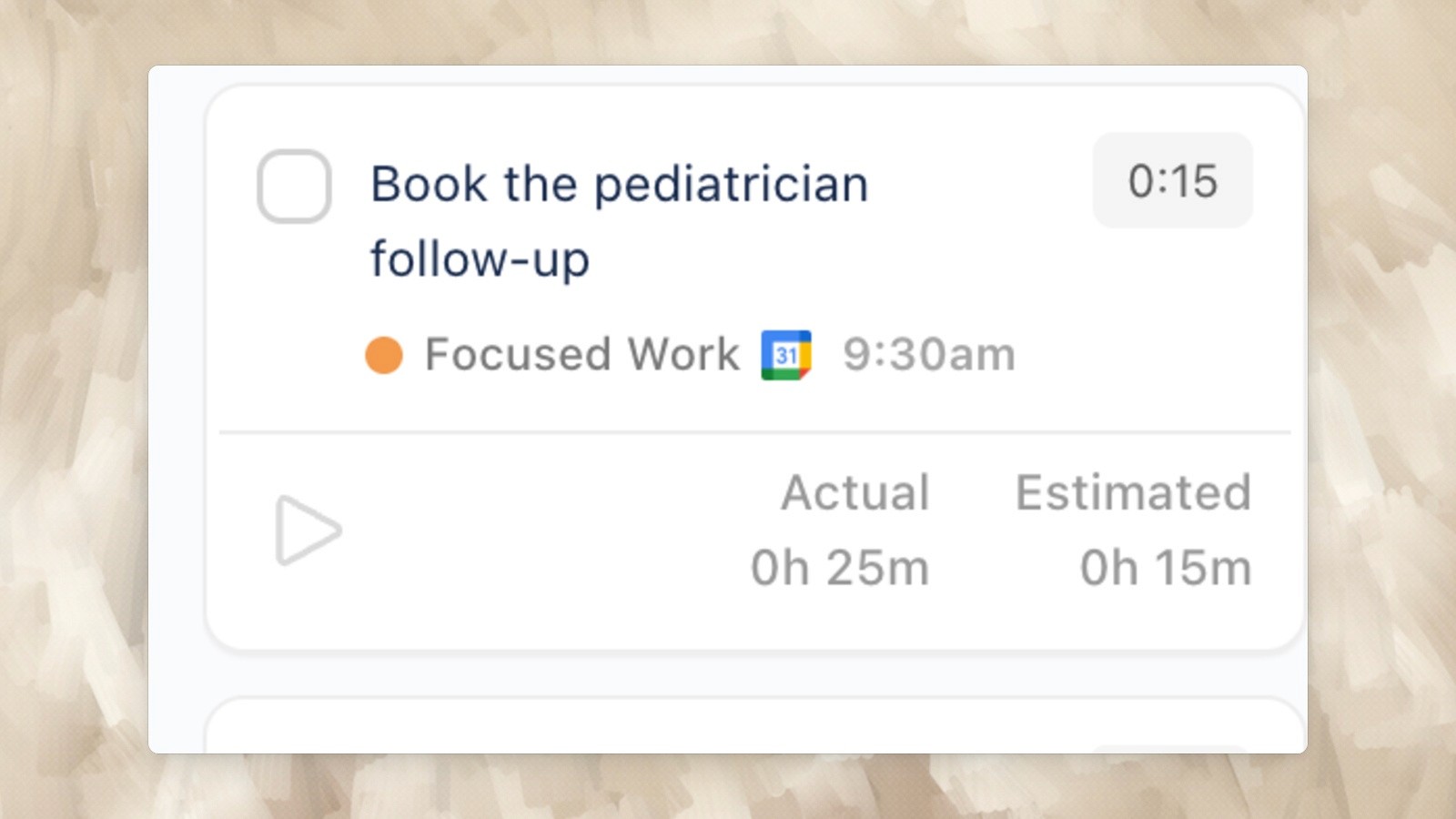
An Ellie demo task shows 15 minutes estimated and 25 minutes actual: useful feedback for the next plan.
When each method fails
Pomodoro fails when
alarms repeatedly break a loaded mental model
the preset interval is treated as a universal law
break count becomes a productivity score
every interruption is labeled a failed session
the day has no room for the planned sequence
Flowtime fails when
you postpone breaks until exhaustion
“natural stop” means the first sign of difficulty
sessions overrun commitments
tracking start and stop is forgotten
you need a smaller promise to begin
Frequently asked questions
Is Flowtime just working without a timer?
No. It still uses intentional single-task focus, start-and-stop records, and deliberate breaks. It moves the stopping decision from a preset interval to observed task and energy boundaries.
Is Flowtime better for ADHD?
Not universally. Flexibility may protect hyperfocus, while a fixed interval may make time and stopping more visible. Test both without treating either as medical care.
How long should a Flowtime break be?
There is no established ratio. Use a short reset after a short or routine session and more recovery after a long or highly demanding one. If the next session begins depleted, extend the break.
Can I mix Flowtime and Pomodoro in one day?
Yes. Use methods by task. Routine and resistant tasks may benefit from strict intervals; immersive work may benefit from natural boundaries.
Sources
Biwer et al., “Understanding effort regulation”, British Journal of Educational Psychology (2023).
Biwer et al., “Investigating the Effectiveness of Self-Regulated, Pomodoro, and Flowtime Break-Taking Techniques Among Students”, Behavioral Sciences (2025).
Albulescu et al., meta-analysis of micro-breaks, PLOS ONE (2022).
Plan a day that can breathe
Ellie keeps tasks beside your calendar, so you can see your real capacity before the day fills up.
