Morgen vs Motion: AI Planning, Control, and Real Costs

Chris Raroque

Morgen’s AI Planner is a good starting point if you want to review a proposed schedule before committing it. Motion is a good starting point if you want tasks automatically scheduled around working hours, priorities, and deadlines.
Both offer more than a place to display appointments. Your choice depends on how you want the plan to be made, where your tasks already live, and what should happen when the day changes.
This comparison uses current product documentation and web pricing, checked September 19, 2026. Ellie publishes this guide and makes a competing daily planner. The trial exercise is a recommendation for your own evaluation; it is not a report of hands-on performance testing.
The practical comparison
Question | Morgen | Motion |
|---|---|---|
How does the documented planning workflow work? | Generate a suggested plan, review it, then approve scheduling. | Automatically place tasks using their scheduling inputs and your availability. |
How do you guide it? | Task information, available capacity, and Frames for types of work. | Working schedules, task durations, priorities, deadlines, and scheduling settings. |
What is the strongest reason to try it? | Bring tasks from several existing tools into a calendar plan. | Let a scheduler maintain a plan around tasks and project commitments. |
What needs care? | Connector behavior and the difference between a proposed plan and a committed one. | Accurate task estimates, realistic priorities, and hard-deadline settings. |
Individual annual starting price | $180/year | $228/year for Pro AI |
This table describes Morgen’s AI Planner workflow, not a promise that every Morgen feature or automation uses the same approval behavior. Always check the mode you are enabling. Morgen planning guide, Motion auto-scheduling guide.
Morgen makes sense when you want a say in the proposed plan
Morgen’s AI Planner uses Frames to guide what kinds of tasks belong in different parts of the day. You can preview the plan and change it before saving. After a plan has been scheduled, its documentation describes conflict notifications and a rescheduling action when a new event overlaps a task. Morgen AI Planner.
That approach may suit you if you want assistance with scheduling but still want to review the arrangement. You might know that a task is technically possible at 4:00 p.m. but is a poor choice after three meetings. A preview gives you a point to make that judgment.
Morgen also lists connections to multiple task systems, including Notion, Todoist, Linear, ClickUp, and Microsoft To Do. If you want to keep those tools, test the relevant connector before migrating any work. An integration list is not proof that subtasks, due dates, priorities, and completion all behave the way you expect. Morgen integrations.
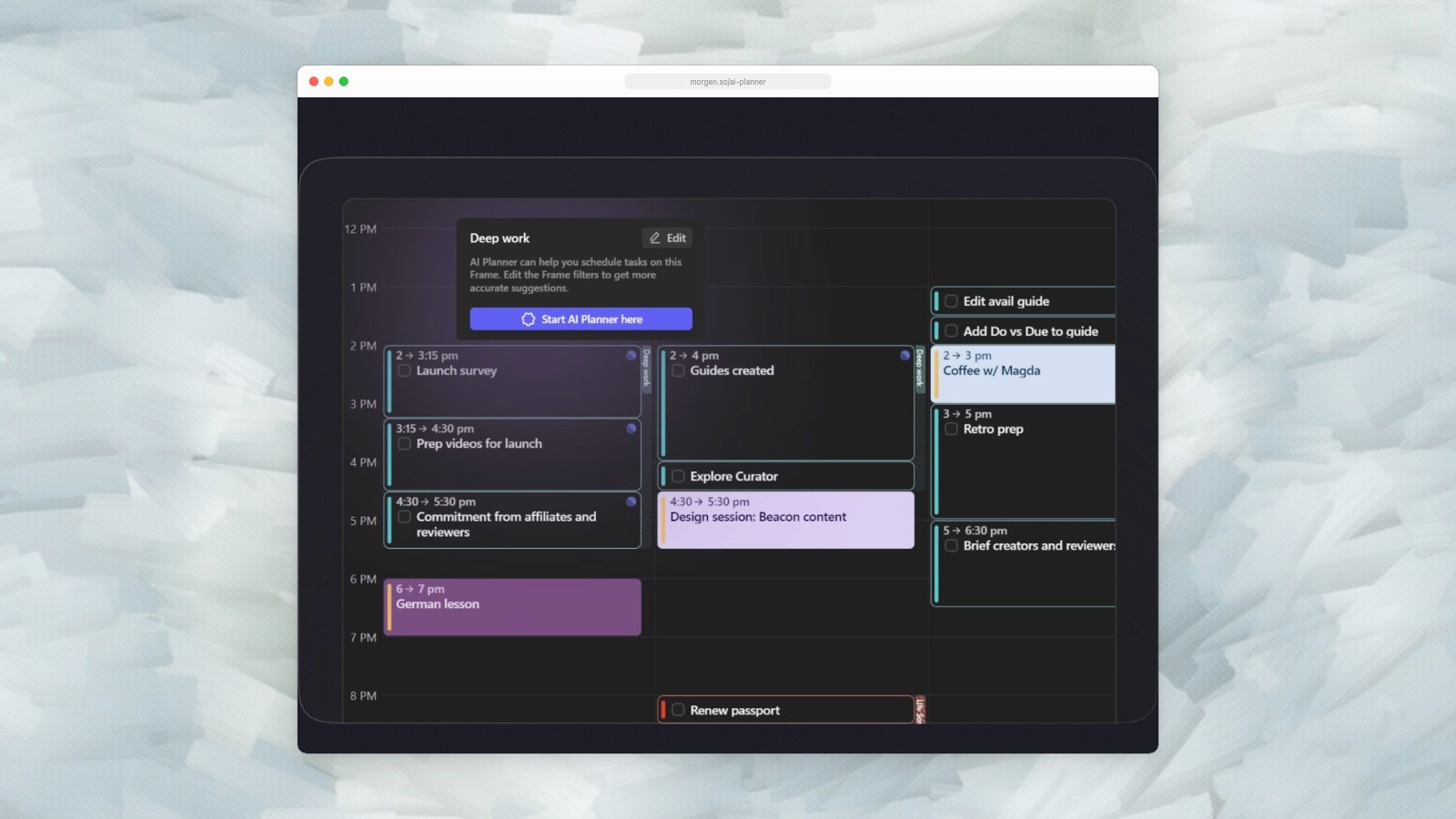
Morgen’s official AI Planner interface, captured September 19, 2026. Source.
Motion makes sense when you want the scheduler to do more of the rearranging
Motion’s auto-scheduler uses working hours, deadlines, and priorities to place tasks. You can assign different schedules to different kinds of work and configure breaks between tasks. You can also pause auto-scheduling for a task. Motion scheduling documentation.
The benefit depends on the inputs you give it. “Finish website” is a difficult item to schedule usefully. “Write the pricing page introduction — 45 minutes — due Thursday” gives you a better starting point.
Pay particular attention to hard deadlines. Motion documents that a task with a hard deadline can be scheduled outside its assigned working schedule. That can be useful for a genuine deadline, but it is a poor default for everything you would merely like to finish soon. Motion’s schedule and deadline behavior.
Do not evaluate the app only by whether it fills your calendar. Evaluate whether the resulting day is one you can carry out.
Compare the same billing commitment
These are USD web prices observed on September 19, 2026. The annual figures below are commitments for a full year, not monthly cancellation prices.
Plan | Month-to-month | Annual equivalent | Annual total |
|---|---|---|---|
Morgen Individual | $30 | $15/month | $180 |
Motion Pro AI | $27/seat | $19/seat/month | $228/seat |
Motion Business AI | $45/seat | $29/seat/month | $348/seat |
The Motion website’s monthly and annual toggles show different amounts. Business AI also includes capabilities beyond the individual scheduling comparison, so do not use its price as if it were the only way to buy Motion. Morgen pricing, Motion pricing.
At these prices, Morgen’s individual plan is $48 less per year than Motion Pro AI on annual billing, while Motion Pro AI is $3 less on month-to-month billing. “Morgen is cheaper” is therefore incomplete without the billing period.
Morgen currently advertises a 14-day trial without a card. Check Motion’s current trial and billing terms at signup before starting its trial; a free trial and a permanent free plan are different things. For a fuller breakdown, see our Morgen pricing guide.

Motion’s annual pricing on the Teams tab, captured September 19, 2026. Source.
Use a disrupted day to test both
A clean calendar makes almost any planner look good. Try this instead:
Task or event | Duration | Timing |
|---|---|---|
Write a proposal | 90 minutes | Due tomorrow |
Review a teammate’s draft | 30 minutes | Due today |
Reply to routine messages | 20 minutes | Flexible |
Client call | 45 minutes | Fixed at 11:00 a.m. |
Personal appointment | 60 minutes | Fixed at 3:00 p.m. |
Leave some unscheduled space. Create the initial plan, then add an unexpected 45-minute meeting where you intended to write the proposal.
Check whether the app makes the displaced work obvious. Inspect what it moves, whether it respects the appointment and your working hours, and whether the new plan leaves enough uninterrupted time for the proposal. If you need to adjust the plan, notice how easy it is to understand and reverse that change.
Then deliberately make one estimate wrong. Let a 30-minute task take 50 minutes. A useful planner should help you decide what to shorten, move, or stop expecting today. It cannot make the missing 20 minutes appear.
For a week, record your planning time, the number of schedule corrections you make, and whether the important task gets done. Those observations are more useful than a feature count.
What if you want to place the tasks yourself?
If the trial reveals that you prefer choosing the blocks manually, you may not need an automatic scheduler. Ellie lets you collect tasks and plan them beside your calendar. It also has optional AI features, so the distinction is control over your workflow rather than a claim that Ellie has no AI.
Ellie’s free plan includes basic task capture and Brain Dump. Timeboxing and calendar integrations require Pro. Compare Ellie’s plans, or use the timeboxing versus time blocking guide to decide how much structure you want before choosing another app.
Morgen’s AI Planner is a good starting point if you want to review a proposed schedule before committing it. Motion is a good starting point if you want tasks automatically scheduled around working hours, priorities, and deadlines.
Both offer more than a place to display appointments. Your choice depends on how you want the plan to be made, where your tasks already live, and what should happen when the day changes.
This comparison uses current product documentation and web pricing, checked September 19, 2026. Ellie publishes this guide and makes a competing daily planner. The trial exercise is a recommendation for your own evaluation; it is not a report of hands-on performance testing.
The practical comparison
Question | Morgen | Motion |
|---|---|---|
How does the documented planning workflow work? | Generate a suggested plan, review it, then approve scheduling. | Automatically place tasks using their scheduling inputs and your availability. |
How do you guide it? | Task information, available capacity, and Frames for types of work. | Working schedules, task durations, priorities, deadlines, and scheduling settings. |
What is the strongest reason to try it? | Bring tasks from several existing tools into a calendar plan. | Let a scheduler maintain a plan around tasks and project commitments. |
What needs care? | Connector behavior and the difference between a proposed plan and a committed one. | Accurate task estimates, realistic priorities, and hard-deadline settings. |
Individual annual starting price | $180/year | $228/year for Pro AI |
This table describes Morgen’s AI Planner workflow, not a promise that every Morgen feature or automation uses the same approval behavior. Always check the mode you are enabling. Morgen planning guide, Motion auto-scheduling guide.
Morgen makes sense when you want a say in the proposed plan
Morgen’s AI Planner uses Frames to guide what kinds of tasks belong in different parts of the day. You can preview the plan and change it before saving. After a plan has been scheduled, its documentation describes conflict notifications and a rescheduling action when a new event overlaps a task. Morgen AI Planner.
That approach may suit you if you want assistance with scheduling but still want to review the arrangement. You might know that a task is technically possible at 4:00 p.m. but is a poor choice after three meetings. A preview gives you a point to make that judgment.
Morgen also lists connections to multiple task systems, including Notion, Todoist, Linear, ClickUp, and Microsoft To Do. If you want to keep those tools, test the relevant connector before migrating any work. An integration list is not proof that subtasks, due dates, priorities, and completion all behave the way you expect. Morgen integrations.
Morgen’s official AI Planner interface, captured September 19, 2026. Source.
Motion makes sense when you want the scheduler to do more of the rearranging
Motion’s auto-scheduler uses working hours, deadlines, and priorities to place tasks. You can assign different schedules to different kinds of work and configure breaks between tasks. You can also pause auto-scheduling for a task. Motion scheduling documentation.
The benefit depends on the inputs you give it. “Finish website” is a difficult item to schedule usefully. “Write the pricing page introduction — 45 minutes — due Thursday” gives you a better starting point.
Pay particular attention to hard deadlines. Motion documents that a task with a hard deadline can be scheduled outside its assigned working schedule. That can be useful for a genuine deadline, but it is a poor default for everything you would merely like to finish soon. Motion’s schedule and deadline behavior.
Do not evaluate the app only by whether it fills your calendar. Evaluate whether the resulting day is one you can carry out.
Compare the same billing commitment
These are USD web prices observed on September 19, 2026. The annual figures below are commitments for a full year, not monthly cancellation prices.
Plan | Month-to-month | Annual equivalent | Annual total |
|---|---|---|---|
Morgen Individual | $30 | $15/month | $180 |
Motion Pro AI | $27/seat | $19/seat/month | $228/seat |
Motion Business AI | $45/seat | $29/seat/month | $348/seat |
The Motion website’s monthly and annual toggles show different amounts. Business AI also includes capabilities beyond the individual scheduling comparison, so do not use its price as if it were the only way to buy Motion. Morgen pricing, Motion pricing.
At these prices, Morgen’s individual plan is $48 less per year than Motion Pro AI on annual billing, while Motion Pro AI is $3 less on month-to-month billing. “Morgen is cheaper” is therefore incomplete without the billing period.
Morgen currently advertises a 14-day trial without a card. Check Motion’s current trial and billing terms at signup before starting its trial; a free trial and a permanent free plan are different things. For a fuller breakdown, see our Morgen pricing guide.
Motion’s annual pricing on the Teams tab, captured September 19, 2026. Source.
Use a disrupted day to test both
A clean calendar makes almost any planner look good. Try this instead:
Task or event | Duration | Timing |
|---|---|---|
Write a proposal | 90 minutes | Due tomorrow |
Review a teammate’s draft | 30 minutes | Due today |
Reply to routine messages | 20 minutes | Flexible |
Client call | 45 minutes | Fixed at 11:00 a.m. |
Personal appointment | 60 minutes | Fixed at 3:00 p.m. |
Leave some unscheduled space. Create the initial plan, then add an unexpected 45-minute meeting where you intended to write the proposal.
Check whether the app makes the displaced work obvious. Inspect what it moves, whether it respects the appointment and your working hours, and whether the new plan leaves enough uninterrupted time for the proposal. If you need to adjust the plan, notice how easy it is to understand and reverse that change.
Then deliberately make one estimate wrong. Let a 30-minute task take 50 minutes. A useful planner should help you decide what to shorten, move, or stop expecting today. It cannot make the missing 20 minutes appear.
For a week, record your planning time, the number of schedule corrections you make, and whether the important task gets done. Those observations are more useful than a feature count.
What if you want to place the tasks yourself?
If the trial reveals that you prefer choosing the blocks manually, you may not need an automatic scheduler. Ellie lets you collect tasks and plan them beside your calendar. It also has optional AI features, so the distinction is control over your workflow rather than a claim that Ellie has no AI.
Ellie’s free plan includes basic task capture and Brain Dump. Timeboxing and calendar integrations require Pro. Compare Ellie’s plans, or use the timeboxing versus time blocking guide to decide how much structure you want before choosing another app.
Give your brain the night off
Dump everything into Ellie, give tomorrow a plan, and close the laptop.
Try Ellie free
Web, Mac, Windows, iPhone and iPad. No credit card required.
