Akiflow vs Motion (2026): AI Scheduler vs Manual Planner

Chris Raroque

The productivity app landscape has become increasingly fragmented. Most people use 10-15 different tools daily—email, calendar, project management, note-taking, communication. The question isn’t just “what app should I use?” but rather “how do I consolidate my workflow across all these tools?” Akiflow and Motion take dramatically different approaches to solving this problem.
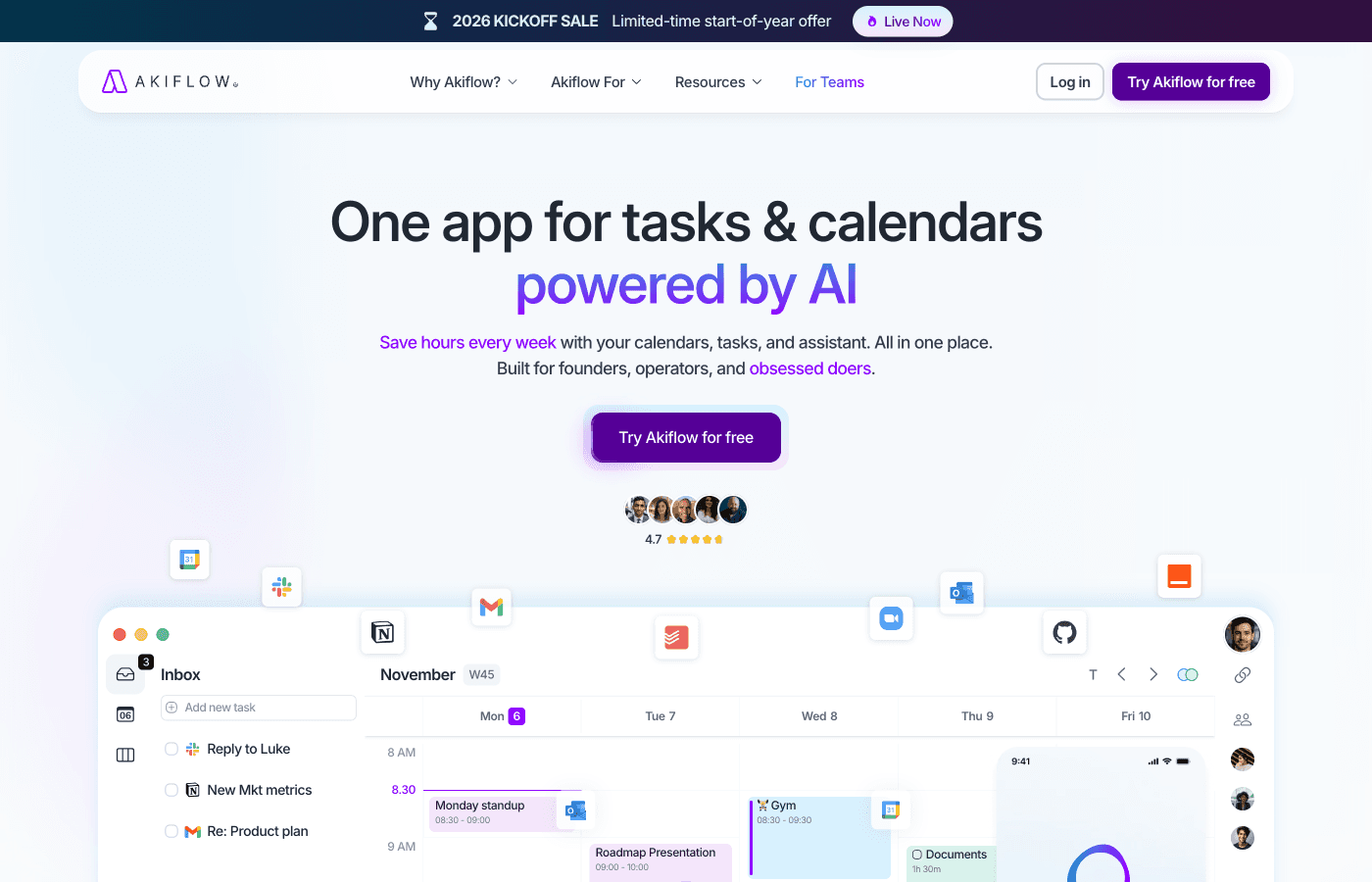
Akiflow positions itself as a command center: a keyboard-driven hub that integrates 80+ external tools into a single interface. Motion, by contrast, emphasizes artificial intelligence and automation: it learns your deadlines, workload, and priorities, then automatically schedules your day for you. One focuses on integration and speed; the other on intelligence and efficiency.
Both tools target serious productivity enthusiasts willing to pay about $19–49 per month for significant workflow improvements. Both offer 7-day trials. Both launched recently enough that the market still considers them innovative alternatives to established tools like Asana, Monday.com, and traditional calendar apps.
But they’re fundamentally different products addressing different problems. This comparison explores where each excels, where each falls short, and how to choose between them.
Head-to-Head Feature Comparison
Where Akiflow Wins
80+ Tool Integrations vs Scattered Solutions
Akiflow’s defining strength is integration breadth. If you use Notion, Jira, GitHub, Linear, Todoist, Asana, Slack, Gmail, Outlook, Trello, Monday.com, Airtable, and a dozen other tools, Akiflow pulls all incoming work into a single inbox. You see what needs your attention across every system without switching contexts.
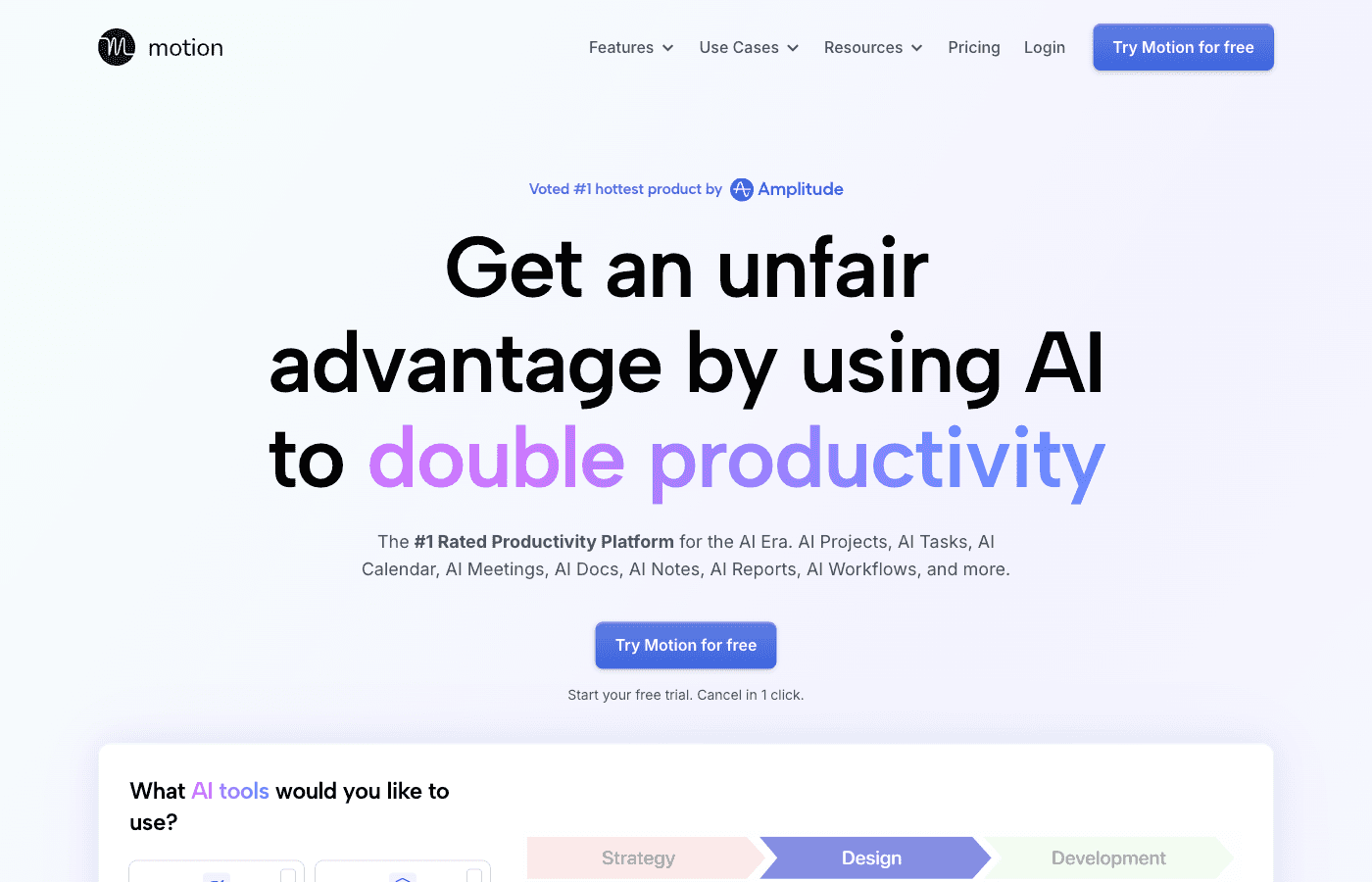
Motion supports popular integrations but covers a narrower ecosystem. This matters significantly if your workflow spans specialized tools. A developer using Linear for issues, Slack for notifications, and Notion for documentation can consolidate everything in Akiflow’s inbox. In Motion, you’d manage tasks within Motion itself and lose the original context from those source systems.
Keyboard-First Design for Speed Enthusiasts
Akiflow’s keyboard shortcuts are extensive and thoughtfully designed. The product was built around the premise that reaching for a mouse breaks flow state.
This appeals to a specific segment: developers, writers, power users, and anyone who spends significant time in text editors or terminals. If you’re already fluent in Vim, Emacs, or VS Code shortcuts, Akiflow’s interaction model feels native. Motion includes keyboard navigation but prioritizes visual interface design.
Unified Task Consolidation
Most people don’t want to maintain tasks in a central system if those same tasks already exist in Asana, Notion, or Todoist. Akiflow syncs with existing tasks from these systems, consolidates them into one view, and marks them complete across both the source tool and Akiflow. You maintain a single source of truth without duplicate entry.
Motion requires you to create tasks within Motion specifically, then optionally connect external work. This creates friction if you’re already managing tasks elsewhere.
Built-in Planning Rituals
Akiflow includes “rituals”—structured prompts that guide you through morning planning, weekly reviews, and daily reflection. These aren’t just templates; they’re integrated workflows that help you approach planning mindfully. Users report this feature transforms scattered task management into a sustainable practice.
Motion lacks equivalent guided planning structures. It’s optimized for auto-scheduling, not for developing intentional planning habits.
One Simple Plan for Individuals
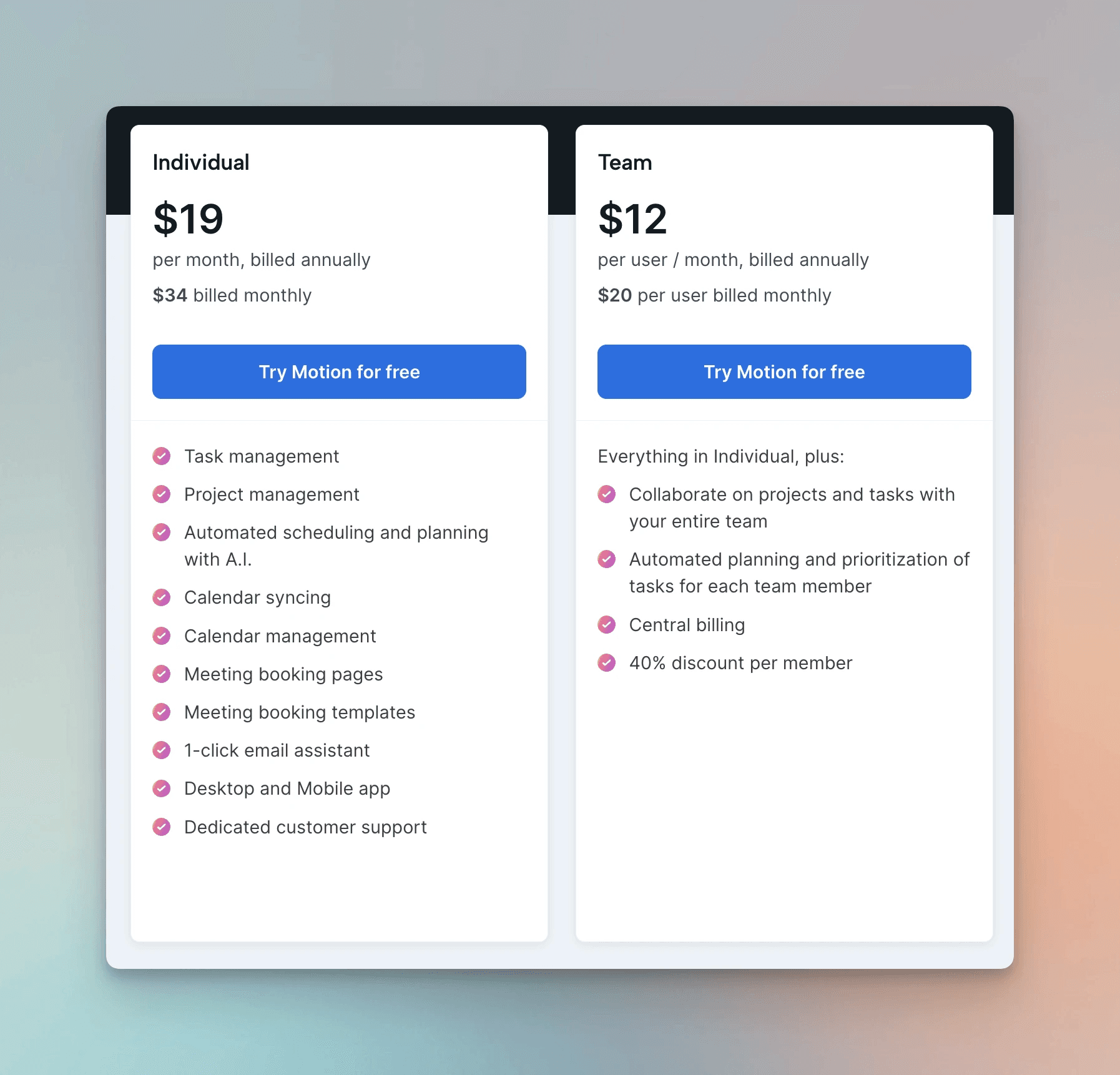
Akiflow has one Pro plan for individuals: $34/month, or $19/month billed yearly. Motion splits its pricing into Individuals and Teams plans with different AI tiers, which takes longer to compare.
Where Motion Wins
AI-Driven Auto-Scheduling Changes the Game
Motion’s core differentiator is its automatic scheduling algorithm. You tell Motion your tasks and deadlines. It analyzes your calendar, committed meetings, existing blocked time, and work duration estimates. Then it schedules everything for you, updating dynamically as your calendar changes.
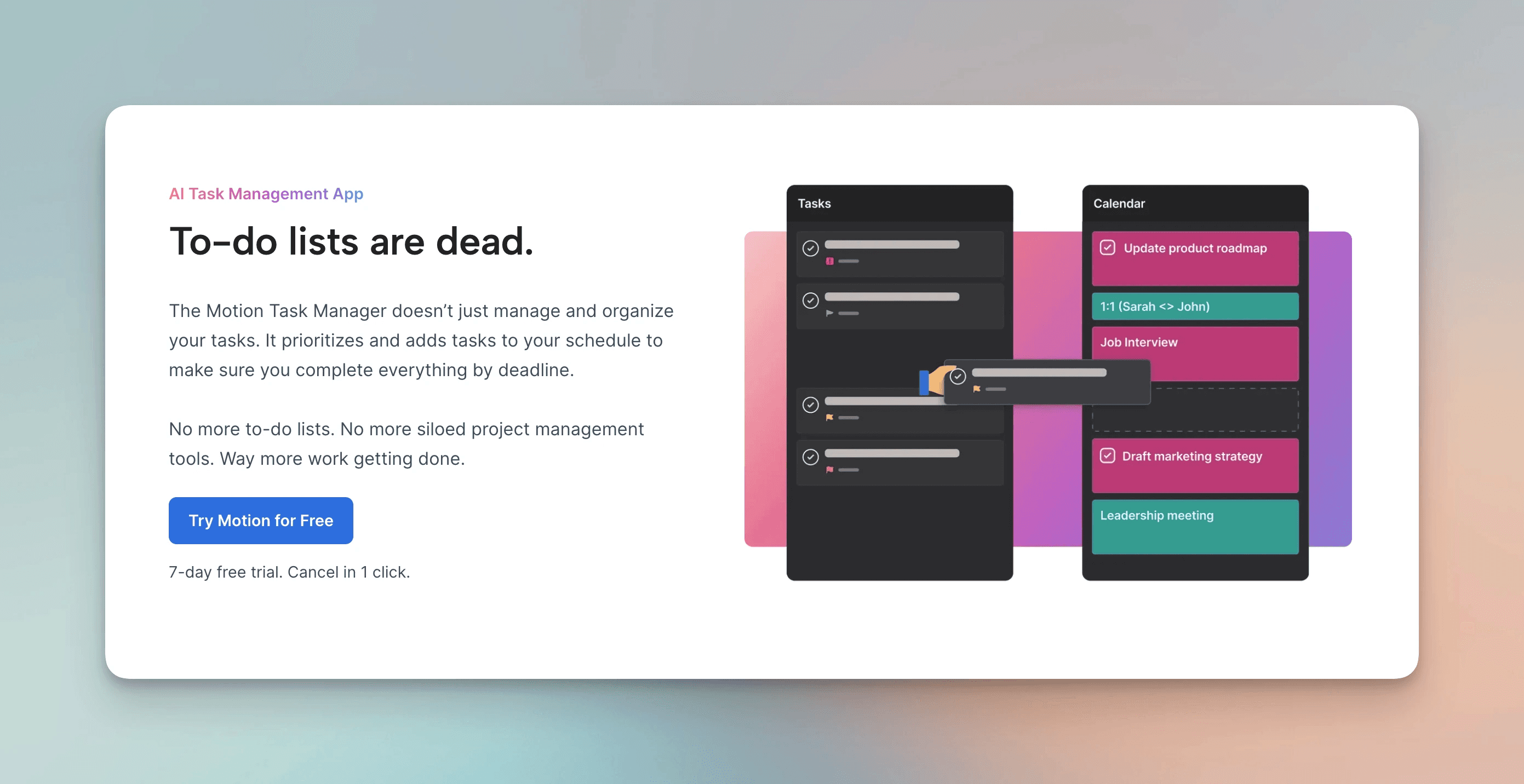
This solves a genuinely hard problem: most people either over-schedule themselves or leave calendars with gaps that should contain focused work. Motion’s AI handles this intelligently. If a meeting runs long, Motion reshuffles your scheduled tasks. If you add a new urgent task with a tight deadline, Motion finds optimal slots automatically.
Akiflow takes a lighter approach: its AI can suggest a schedule, but you place most work on your calendar yourself. If you want your day re-planned automatically, Motion goes further.
Full Project Management Capabilities
Motion includes Kanban boards, timeline views, workflow status states, and project organization. Akiflow focuses on task consolidation and doesn’t include native project management.
If you need to track related tasks as part of projects (with progress visualization, team visibility, and status workflows), Motion handles this natively. Akiflow would integrate with your existing project management tool but doesn’t replace it.
Deadline Intelligence and Smart Scheduling
Motion understands deadline urgency. It analyzes how much unscheduled time you have relative to approaching deadlines, then proactively alerts you and schedules time accordingly. This goes beyond simple date fields—it’s contextual deadline intelligence.
If you have five tasks with deadlines in the next week but only 8 hours scheduled to work, Motion flags this and proposes a schedule that actually delivers. Akiflow shows the dates but requires you to manually assess capacity and decide what to schedule when.
Team Collaboration and Delegation
Motion includes team features: shared projects, delegation, team calendars, and workload balancing across team members. Akiflow focuses on each person’s own tasks and calendar, with team scheduling extras like booking links and team calendars. If you need to collaborate with others on scheduled work, Motion is the clear choice.
Mobile Apps
Both have iOS and Android apps. Motion’s phone app shows your scheduled tasks and calendar. Akiflow’s phone app handles tasks, calendar and reminders, but its planning rituals and focus timer stay on desktop.
For most professionals, mobile access to your tasks and scheduled day is essential, so check which of your daily habits each app supports on the phone before you commit.
Where Both Fall Short
Premium Pricing Without Premium Accessibility
Both tools cost roughly $19–49 per month depending on plan and billing—about $228–588 a year. Neither tool offers a free tier or genuinely limited free plan, creating a high barrier to adoption compared to Todoist ($7/month) or Notion ($10/month).
This pricing makes sense if the tools deliver exceptional value, but it also means they exclude large segments of the market: students (except through educational discounts), solopreneurs with tight budgets, and people wanting to trial alternatives to expensive professional tools.
Lack of Daily Planning Rituals (Motion) or Full Auto-Scheduling (Akiflow)
Ideally, a comprehensive productivity tool would combine Akiflow’s integration strength with Motion’s smart scheduling, plus structured planning rituals that both currently lack in meaningful ways.
Akiflow users schedule most tasks themselves despite having a unified inbox. Motion users get automated scheduling but miss the intentional, ritual-based planning that transforms ad-hoc task management into a sustainable practice. You get to choose which limitation to accept, but neither solution is complete.
Onboarding Complexity
Both tools have steep learning curves. Akiflow’s keyboard shortcuts and interface philosophy require investment to master. Motion’s project management and scheduling logic take time to understand and configure properly.
Neither tool offers drop-in simplicity for casual users. Both require commitment and learning to extract real value. This isn’t necessarily a flaw—power users expect this trade-off—but it’s worth acknowledging.
Pricing Comparison
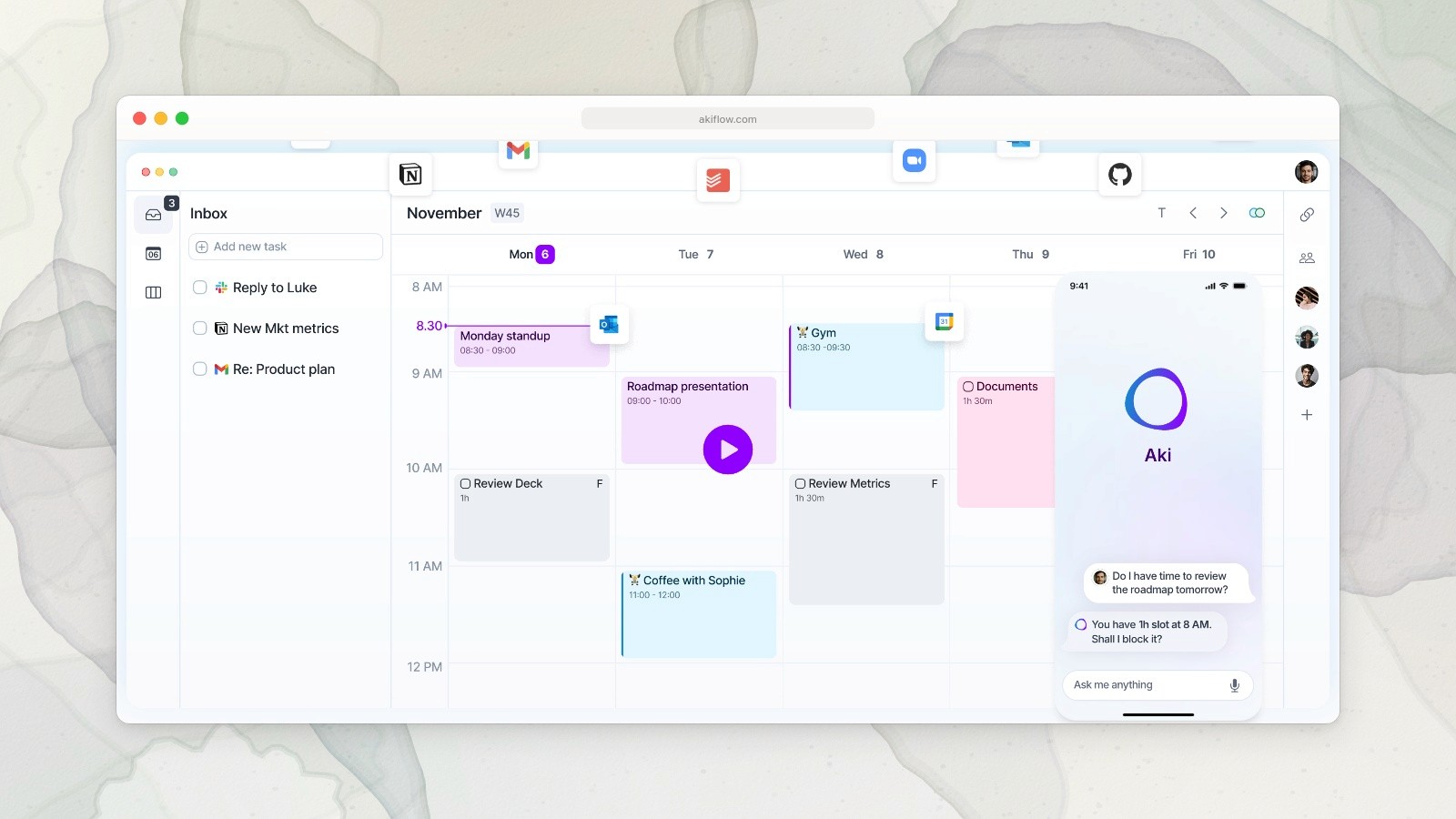
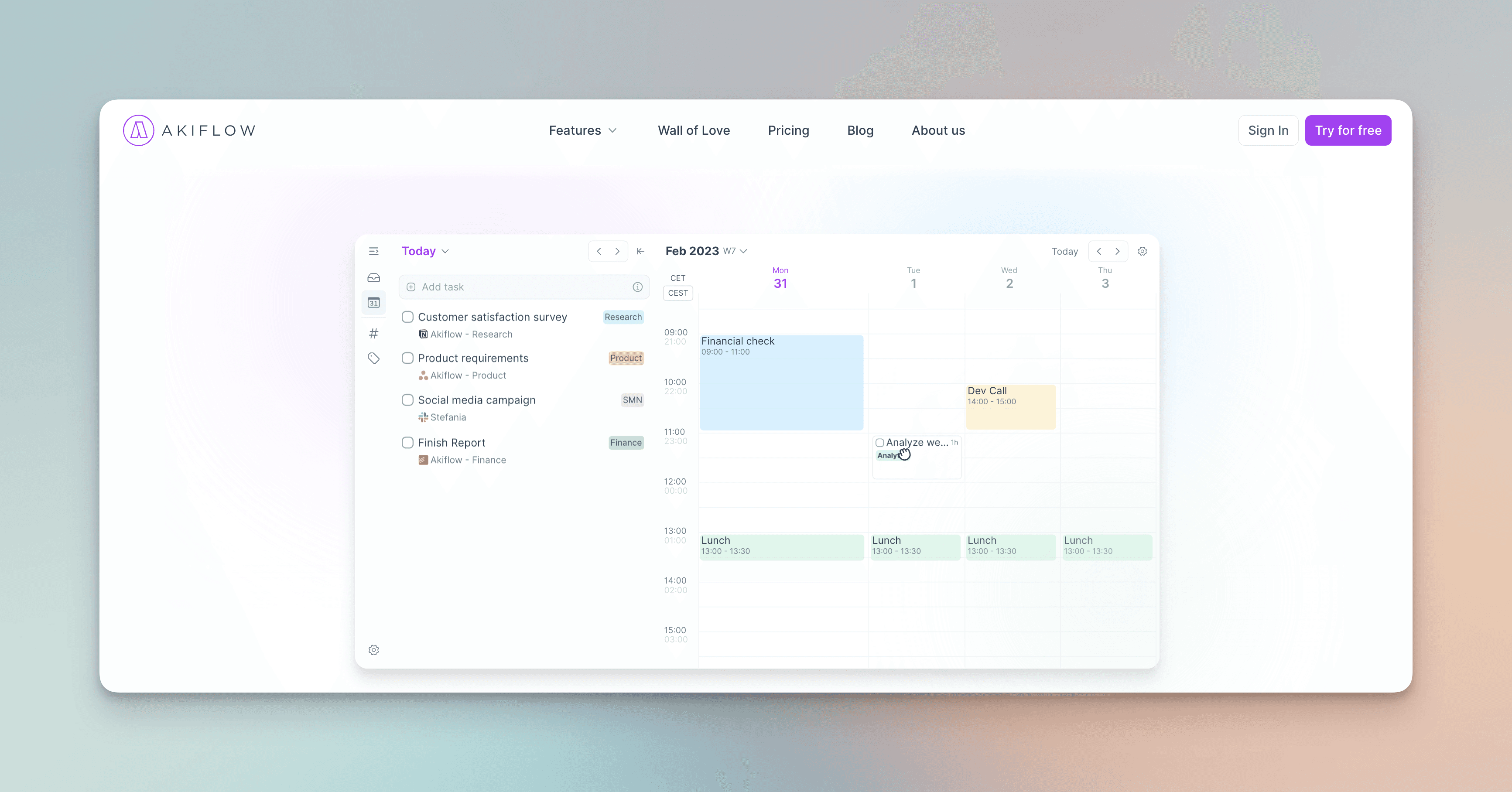
Akiflow’s calendar, task inbox and Aki assistant.
Billed yearly, Akiflow costs $19/month and Motion’s Individuals Pro AI plan costs $29/month. Billed monthly, it’s $34 for Akiflow and $49 for Motion.
Who Should Choose What
Choose Akiflow If:
You use 5+ different productivity and work tools and want them consolidated into one inbox
You’re a keyboard-driven power user who values speed and minimizing mouse movement
You work solo and need a personal productivity command center, not team features
You want to maintain tasks in existing systems (Notion, Asana, etc.) without duplicating entries
You’re interested in structured planning rituals and mindful task management approaches
You want lower pricing ($34 vs $49 a month, or $19 vs $29 billed yearly)
Choose Motion If:
You want AI to automatically schedule your tasks and manage your calendar intelligently
You need project management features (boards, timelines, workflow states)
You collaborate with teammates and need shared projects and delegation
You want your plan to update itself automatically when your day changes
Deadline awareness and smart scheduling are higher priorities than integration breadth
You prefer visual, calendar-centric interfaces over keyboard-driven navigation
Consider Both If:
If you’re torn, use both during your 7-day trial periods. Akiflow and Motion don’t directly conflict—they address different workflows. Some power users run both simultaneously: Akiflow as their task consolidation hub and Motion as their calendar-scheduling intelligence layer. This requires discipline to avoid duplicate task entry but can work if you use Akiflow for “what needs doing” and Motion for “when it gets scheduled.”
The Missing Piece: Complete Daily Planning
Neither Akiflow nor Motion fully solves daily planning in the way that thoughtful productivity practitioners want. Akiflow offers planning rituals but leaves most scheduling to you. Motion offers intelligent scheduling but minimal planning structure. Both miss the opportunity to combine mindful planning with smart automation.
An ideal solution would prompt you through morning intention-setting (what matters today?), then use AI to schedule those priorities intelligently, then guide you through evening reflection (what did I accomplish? What’s unfinished?). Instead, you’re choosing between ritual-focused consolidation (Akiflow) or automation-focused scheduling (Motion).
Introducing Ellie: The Daily Planning Approach
While researching comprehensive productivity solutions, another category of tools focuses specifically on daily planning as the core interface: structured daily workflows rather than trying to be everything for everyone.
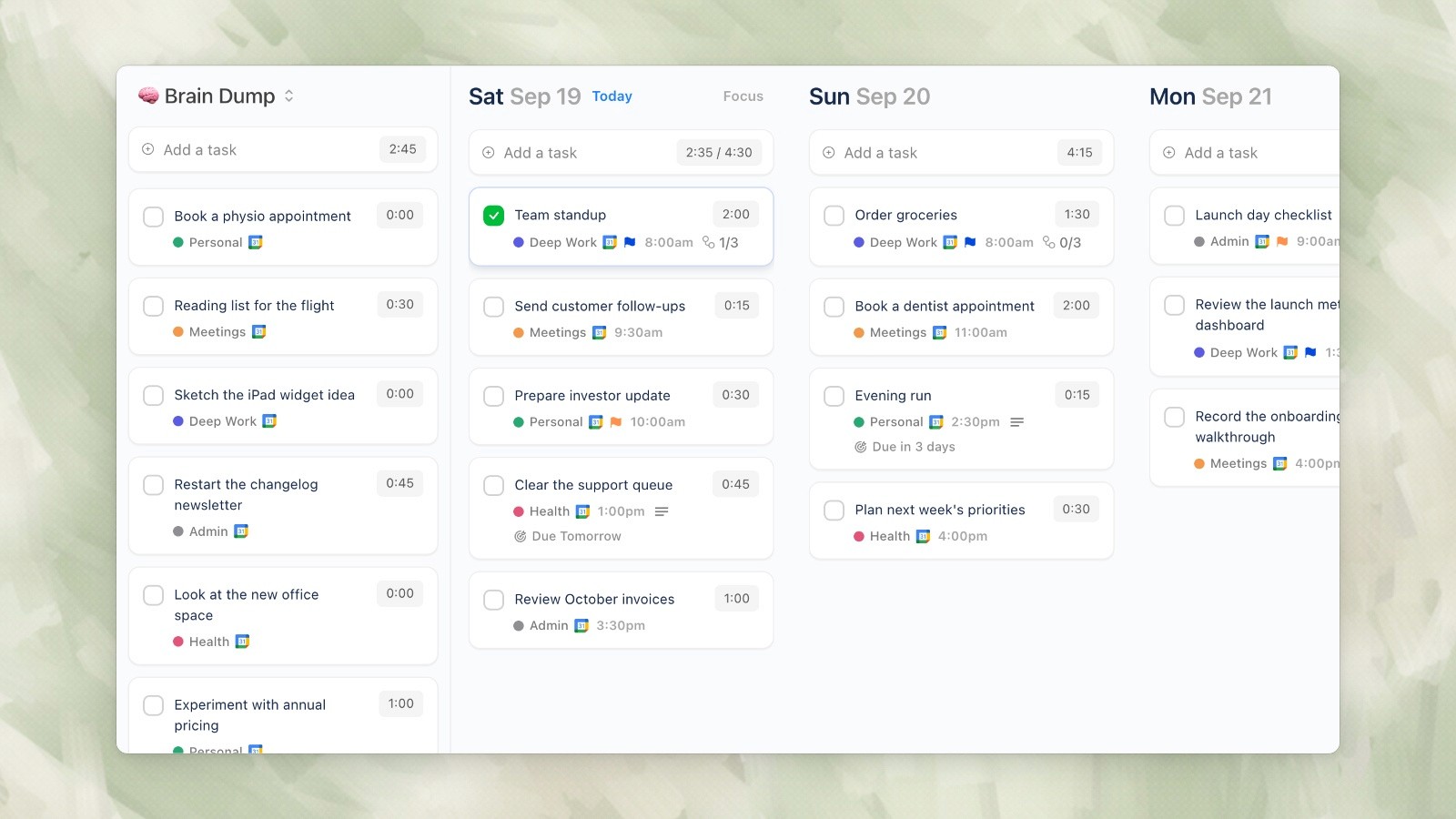
Ellie represents an alternative approach to the Akiflow-vs-Motion decision. Rather than positioning itself as a command center or an AI autopilot, Ellie focuses on guided daily planning: a brain dump inbox where you externalize everything on your mind, a kanban view for organizing work, timeboxing to create realistic daily schedules, and calendar integration to see how your plans fit within your committed time.
Ellie has a free plan, and Ellie Pro is $9.99/month or $99.99/year, with 50% off the yearly plan for students and teachers.
Where Ellie differs: it’s not designed to replace all your tools or automatically schedule everything. Instead, it’s a daily planning layer that helps you approach your work more mindfully. You can keep tasks in tools like Todoist or Notion, sync them into Ellie, and use Ellie as your daily planning and intention-setting interface. It’s more lightweight than Akiflow’s consolidation vision but more structured than Motion’s pure automation.
If you find Akiflow’s integration breadth overwhelming or Motion’s automation insufficient for intentional planning, Ellie offers a middle ground: simplicity and daily ritual. It won’t consolidate your entire tool stack or schedule your week, but it provides sustainable daily structure that busy professionals often lack.
Final Verdict
Akiflow and Motion represent two distinct philosophies of productivity improvement. Akiflow says: “Let’s consolidate all your scattered tools into one powerful hub, optimized for speed.” Motion says: “Let’s use AI to make intelligent scheduling decisions for you, so your calendar stays realistic and deadlines get met.”
Both are well-designed products backed by teams that understand their users. Neither is objectively “better”—better depends on your workflow, team structure, integration needs, and relationship with automation.
If you spend your day juggling 10+ different applications and want to see everything in one place, Akiflow wins. If you’re overwhelmed by calendar scheduling complexity and want AI to handle it, Motion wins. If you want rituals, simplicity, and affordability, neither is a perfect fit—but that’s where newer tools like Ellie are filling gaps.
The productivity market is healthily fragmented these days. Rather than one tool claiming to do everything, specialized tools excel at specific problems. Use this comparison to identify which problem you’re actually trying to solve, then pick the tool designed for that problem.
Give your brain the night off
Dump everything into Ellie, give tomorrow a plan, and close the laptop.
Try Ellie free
Web, Mac, Windows, iPhone and iPad. No credit card required.
